
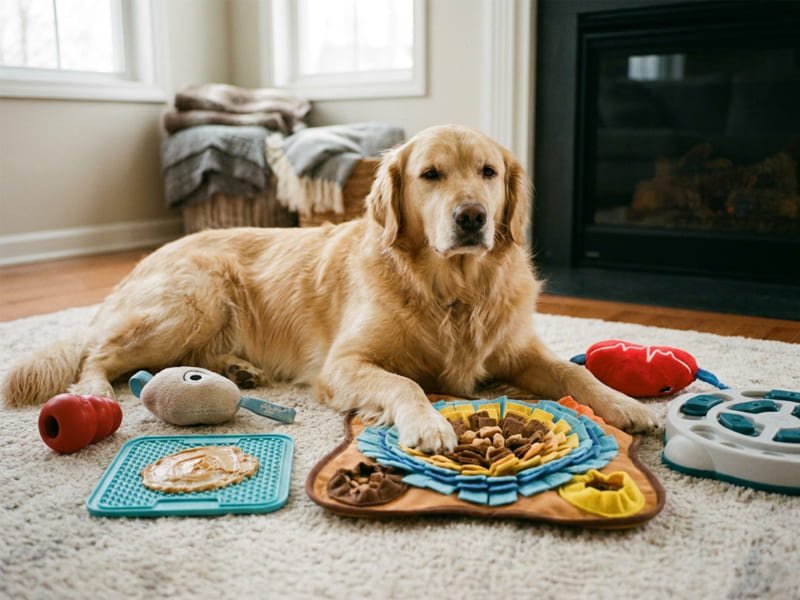
I work directly with brands struggling to select separation anxiety toys, and I see the same mistake every time. They order "durable chew toys" hoping to solve anxiety problems, then deal with returns when customers complain the toys didn’t help. The issue is clear: they conflate product durability with anxiety relief function. These are two different problems requiring different product mechanisms.
When clients ask me which dog toy relieves separation anxiety, I first confirm three things: the dog’s anxiety severity (mild nervousness vs. destructive panic), unsupervised duration (2 hours vs. full workday), and usage environment (crate vs. free-roaming). These variables determine whether they need calming plush toys, energy-draining treat dispensers, or companionship substitutes. Without this framework, you stock the wrong category and watch return rates climb.
If you’re expanding into this niche or testing new SKUs, understanding these selection variables will prevent costly inventory mistakes. Let me walk you through the decision logic we use when helping clients match products to their end-users’ actual problems.
What Mechanisms Actually Relieve Separation Anxiety in Dog Toys?
Most buyers enter this category thinking any tough chew toy works for anxious dogs. This assumption causes problems. I spend half my client consultations explaining the difference between bite-resistant construction and anxiety relief design.
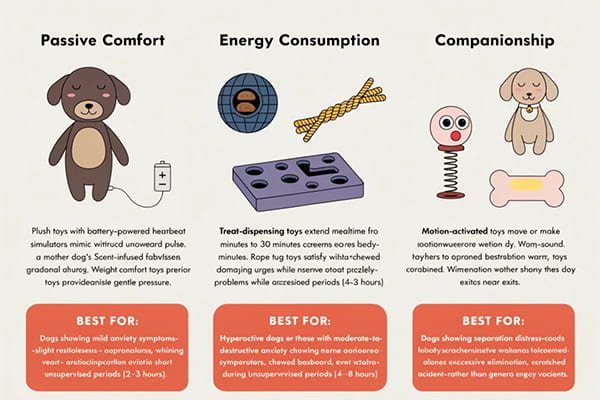
Anxiety relief requires specific functional mechanisms: calming stimulation (heartbeat simulation, scent infusion, texture comfort), energy consumption (treat puzzles, rope tugs, durable rubber for extended chewing), or companionship substitution (motion activation, warming elements, sound feedback).1 Durability addresses jaw strength; these mechanisms address emotional state. A toy can be both durable and calming, but durability alone doesn’t calm anything.
Here’s where client inquiries reveal the confusion. Someone asks for "the best anxiety toy," but they haven’t defined the problem. Is the dog pacing and whining (mild anxiety needing calming mechanisms), destroying furniture (panic needing energy-draining distraction), or crying at the door (isolation fear needing companionship cues)? The answer changes the product category entirely.
Based on our production experience with different structures and client feedback patterns, I group anxiety toys by function mechanism rather than material or price point. This changes how you think about inventory planning.
Calming toys use sensory elements to reduce stress. Plush toys with battery-powered heartbeat simulators mimic a mother dog’s pulse.2 Scent-infused fabric toys release lavender or chamomile gradually.3 Weighted comfort toys provide gentle pressure. These work for dogs showing mild anxiety symptoms—slight restlessness, occasional whining—during short unsupervised periods of 2-3 hours. The mechanism is passive comfort, not active distraction. In client inquiries, we observe these get specified most often for smaller breeds or puppies adjusting to alone time.
Energy-consuming toys redirect destructive behavior into acceptable channels. Treat-dispensing rubber toys make dogs work for food, burning mental energy.4 Rope tug toys satisfy chewing urges without furniture damage. Hard rubber puzzle feeders extend mealtime from 5 minutes to 30 minutes. These work for hyperactive dogs or those with moderate-to-severe anxiety showing destructive symptoms—chewed baseboards, scratched doors—during 4-8 hour periods. The mechanism is mental and physical exhaustion, not emotional soothing. Based on returned product feedback patterns, these get returned less often when paired with usage instructions explaining the energy-drain concept to end customers.
Companionship toys simulate presence to reduce isolation fear. Motion-activated toys move or make sounds when dogs approach, creating interaction.5 Warming plush toys feel body-temperature warm. Sound-emitting toys play heartbeat rhythms or recorded owner voices. These work for dogs showing separation distress specifically—destructive behavior only when alone, excessive vocalization, elimination accidents near exits—rather than general hyperactivity. The mechanism is presence substitution. In our experience with these structures, they perform better in crate environments where the dog can cuddle the toy, versus free-roaming spaces where dogs ignore stationary objects.
This functional breakdown matters because your target end-user hasn’t already categorized their dog’s problem this way. If you stock only energy-consuming toys but your retail buyers serve customers with isolation-fear dogs, your inventory sits unsold. Match function mechanism to the behavioral symptom your market actually faces.
How Do I Match Toy Selection to Different Anxiety Severity Levels?
Clients often ask for "one good anxiety toy" to test the category. This approach fails because anxiety severity determines which mechanism works. A mild-anxiety dog ignores energy-draining puzzles as too frustrating. A panic-level dog destroys calming plush toys in minutes.
Anxiety severity falls into three practical tiers for sourcing decisions: mild nervousness (pacing, light whining, reversible with distraction), moderate anxiety (consistent vocalization, minor property damage, difficult to redirect), and severe panic (destructive escape attempts, self-harm, elimination accidents).6 Each tier requires different product durability levels and mechanism types. Mismatching these results in product failure and returns.

I’ll break down the decision logic we use when guiding clients through this matching process.
For mild nervousness, I recommend starting with calming mechanism toys in moderate durability. Dogs at this level don’t exhibit destructive chewing, so you don’t need industrial-grade rubber. Instead, prioritize sensory comfort features. Plush toys with machine-washable covers and replaceable heartbeat modules work well—the dog gets texture comfort without buyers worrying about battery replacement costs. Scent-infused rope toys offer chew satisfaction while releasing calming scents, combining two mechanisms. Based on client feedback patterns, these perform best when marketed for "first-time alone training" or "short absences," setting correct end-user expectations about duration and symptom severity.
For moderate anxiety, combine energy-consuming and calming mechanisms in higher durability materials. Dogs at this level need distraction plus comfort. Treat-dispensing toys made from food-grade rubber with adjustable difficulty levels work because they extend engagement time—critical for 4-6 hour unsupervised periods. Frozen treat toys (rubber toys filled with frozen peanut butter or yogurt) add duration through the melting process.7 In our production experience with these structures, buyers often underestimate the importance of cleaning ease. Toys with wide openings and dishwasher-safe materials get reordered; complex puzzle toys with narrow crevices get abandoned after one use because owners can’t clean them properly.
For severe panic, prioritize safety-rated durability with companionship mechanisms. Dogs at this level destroy standard toys and risk ingestion injuries.8 You need veterinary-grade rubber meeting choke-hazard testing standards, reinforced stitching on plush elements, and non-toxic materials certified for aggressive chewing. But durability alone doesn’t address the panic. Motion-activated companionship toys need to survive being thrown or stepped on. Warming plush toys need to be machine-washable because anxious dogs often eliminate on comfort objects. Based on returned product feedback patterns, this tier has the highest return rate if buyers stock it without understanding their end market’s actual symptom severity—because severe anxiety often requires behavioral intervention beyond toys9, setting unrealistic product expectations.
Here’s the selection framework I use in client consultations:
| Anxiety Severity | Primary Symptoms | Recommended Mechanism | Durability Level | Typical Duration | Common Mistakes |
|---|---|---|---|---|---|
| Mild | Pacing, light vocalization | Calming (heartbeat, scent) | Moderate | 2-3 hours | Overpaying for extreme durability |
| Moderate | Consistent barking, minor damage | Energy-consuming + calming | High | 4-6 hours | Ignoring cleaning difficulty |
| Severe | Escape attempts, self-harm | Companionship + safety-rated | Veterinary-grade | 6-8+ hours | Stocking without behavior disclaimer |
This framework prevents the most common sourcing mistake: ordering based on mechanism appeal rather than your end market’s actual symptom distribution. If you serve Amazon customers buying impulse solutions for mild symptoms, severe-panic toys sit in inventory. If you serve specialty pet stores where customers seek veterinary-referred products, mild-anxiety toys underperform.
What Usage Scenarios Change the Toy Selection Decision?
Anxiety severity tells you which mechanism to prioritize. Usage scenario tells you which structural features matter. I see buyers skip this variable constantly, then struggle with returns because the toy didn’t fit the customer’s actual setup.
Usage scenarios break into three critical variables: supervised vs. unsupervised duration (impacts safety features and engagement length), crate vs. free-roaming environment (changes size and attachment needs), and single-dog vs. multi-dog households (affects resource-guarding risks and shared-toy durability). Each scenario requires different product specifications even within the same anxiety severity level.
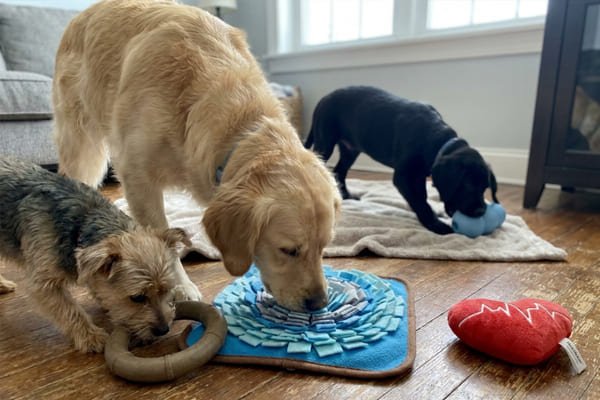
Let me walk through the decision logic using real variables from client inquiries.
Unsupervised duration directly determines engagement mechanism design. For 2-3 hour absences, simple treat-dispensing toys work—the dog doesn’t need extended engagement, just initial distraction during departure anxiety. For 6-8 hour workdays, you need layered engagement: toys that release treats slowly over hours, or combinations of puzzle toys that reset the dog’s interest when one gets solved. In our production experience with slow-release treat toys, the difficulty adjustment feature matters more than buyers expect. End customers abandon toys that dispense too quickly (dog finishes in 20 minutes, then resumes anxious behavior) or too slowly (dog gives up in frustration, reinforcing anxiety). Adjustable difficulty lets them calibrate to their specific dog’s persistence level.
Crate environment changes size and safety requirements completely. Crate toys must fit the space without creating choking hazards if the dog gets wedged against crate walls. This eliminates large puzzle toys or anything with detachable parts that could trap paws. Instead, crate-safe options include flat rubber mats with embedded treat pockets, crate-attachable fabric toys that can’t be swallowed whole, or small heartbeat plush toys sized for cuddling without obstruction risks. Based on client feedback patterns, crate toys get returned most often when buyers stock free-roaming toy sizes without checking crate compatibility—the customer’s dog can’t even interact with the toy properly.
Free-roaming environment requires different durability and size considerations. Dogs have space to throw, carry, and aggressively manipulate toys, so construction needs to survive impact and rough play. Larger puzzle toys work here because space isn’t constrained. Motion-activated toys perform better because dogs can trigger them from different angles. But free-roaming also means the toy competes with furniture, shoes, and other household items for the dog’s attention. In our experience with these structures, toys with strong scent elements (food residue, infused calming scents) or sound feedback (squeakers, crinkle material) get chosen over silent objects. The toy needs to be more interesting than the couch.
Multi-dog households add resource-guarding complexity. Even non-anxious dogs guard high-value items like treat toys. In households where one dog has separation anxiety, introducing treat-dispensing toys can create aggression between dogs rather than calming the anxious one.10 For these scenarios, I recommend either individual crating with separate toys, or low-value companionship toys that don’t trigger competition—simple comfort objects without food motivation. Based on returned product feedback patterns, multi-dog returns cite "caused fighting" more often than product quality issues. This isn’t a toy defect; it’s a selection mismatch. Buyers need to either specify single-dog usage in product descriptions or stock non-food-motivated options for multi-dog homes.
Here’s how I frame scenario-based selection in consultations:
Short absences (2-3 hours) + crate + single dog:
Small treat-dispensing toys, crate-safe heartbeat plush, frozen treat options that fit crate floor space. The dog needs initial distraction, not all-day engagement.
Full workday (6-8 hours) + free-roaming + single dog:
Large puzzle feeders with adjustable difficulty, motion-activated companionship toys, multiple toy rotation (2-3 toys swapped weekly to maintain novelty). The dog needs sustained engagement and self-entertainment.
Variable schedule + free-roaming + multi-dog:
Non-food companionship toys, multiple low-value comfort objects distributed through the house, or separate crating with individual treat toys. The dog needs anxiety relief without triggering pack competition.
This scenario framework prevents inventory dead stock. If your market is urban apartment dwellers (typically crate users with short absences), stocking large free-roaming puzzle toys means slow turnover. If your market is suburban families (free-roaming, longer absences), crate-specific toys underperform. Match structural features to your actual end-user’s physical setup.
How Do Material and Construction Choices Impact Different Anxiety Applications?
Clients often focus on mechanism and scenario but skip material selection until production. This creates problems because material determines whether the toy survives its intended use case and whether end customers perceive it as worth the price.
Material choice must match both the anxiety severity and the intended mechanism. Calming toys need texture comfort and washability; energy-consuming toys need bite-resistance and food-safety; companionship toys need durability with sensory feedback. Using the wrong material for the mechanism creates product failures that feel like manufacturing defects but are actually specification errors.
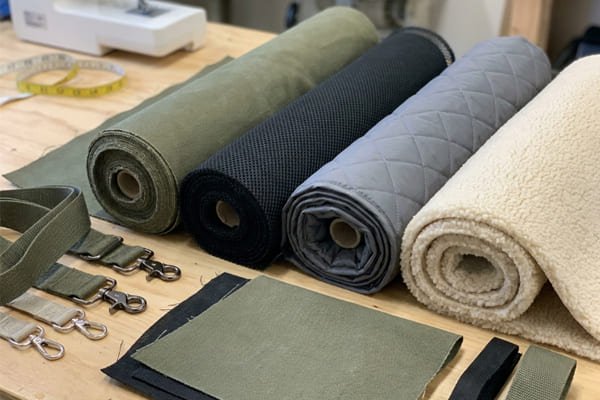
I’ll break down material trade-offs based on our direct production experience with different anxiety toy structures.
For calming mechanism toys, fabric selection determines comfort and lifespan. Plush toys need machine-washable covers because anxious dogs drool on comfort objects. We typically use polyester fleece or microfiber—soft enough for cuddle comfort, durable enough for repeated washing cycles. Cotton feels premium but shrinks and pills after washing. In client inquiries, buyers often want "all-natural materials" for calming toys, but natural cotton doesn’t survive the washing frequency these toys require. The compromise is certified non-toxic polyester with natural scent infusion (lavender sachets, cedar chips in separate pockets). This delivers the calming scent they want with the washability they need. For heartbeat module pockets, we use reinforced stitching and Velcro closures rather than zippers—zippers break under repeated opening for battery changes, while Velcro stays functional longer.
For energy-consuming toys, rubber grade and hardness matter more than buyers expect. Food-grade silicone works for treat dispensers because it’s easy to clean and dogs can’t chip pieces off, but it’s too soft for aggressive chewers—they’ll tear through it in days. Natural rubber (latex-free to avoid allergies) offers better bite resistance but stains easily and absorbs food odors even after washing. Synthetic rubber blends balance durability and cleanliness but need proper hardness selection. We measure this in Shore A durometer scale: 60A-70A for mild chewers (softer, more comfortable), 80A-90A for moderate-to-severe destruction (harder, more durable).11 In our production experience, buyers often order the hardest rubber thinking it lasts longest, but if it’s too hard for the dog’s jaw strength, the dog ignores the toy entirely. Match rubber hardness to your market’s breed size distribution.
For companionship mechanism toys, material needs to deliver sensory feedback while surviving rough treatment. Motion-activated toys need impact-resistant ABS plastic housings because dogs drop or throw them. The motion sensor itself needs to be sealed against drool and impact shock. Sound-emitting toys need waterproof speaker components—I’ve seen too many returned units where internal electronics corroded from saliva exposure. Warming plush toys need fabric that safely conducts heat without creating burn risks. We use double-layer construction: an inner heat-safe synthetic fiber layer that distributes warmth evenly, and an outer soft fabric layer that feels comfortable. Single-layer designs create hot spots that can discomfort dogs. Based on returned product feedback patterns, the most common companionship toy failure is moisture damage to electronic components. If you’re sourcing these, verify IP ratings (IPX4 minimum for splash resistance) and sealed battery compartments.12
Here’s the material selection framework I use in client consultations:
| Toy Mechanism | Primary Material | Key Requirements | Common Failures | Production Notes |
|---|---|---|---|---|
| Calming (plush) | Polyester fleece | Washable, non-toxic | Cotton shrinkage | Reinforced stitching for modules |
| Energy (treat dispenser) | Food-grade rubber | Bite-resistant, cleanable | Wrong hardness | Match Shore A to breed size |
| Companionship (electronic) | ABS plastic + sealed electronics | Moisture-resistant, impact-safe | Corrosion from drool | Minimum IPX4 rating |
| Hybrid (rope with scent) | Cotton-poly blend | Fray-resistant, scent-holding | Pure cotton fraying | Knotted ends with sealed cores |
One more material consideration buyers miss: color and texture visibility. Anxious dogs respond to visual contrast—a toy that blends into carpet gets ignored. In our production runs, brightly colored toys (orange, blue, green) show
-
"Dogs can discriminate between human baseline and psychological …", https://pmc.ncbi.nlm.nih.gov/articles/PMC9518869/. Research on canine behavior modification supports that environmental enrichment strategies, including sensory stimulation and food-dispensing activities, can reduce stress-related behaviors in dogs experiencing separation distress, though effectiveness varies by individual animal and anxiety severity. Evidence role: mechanism; source type: research. Supports: that environmental enrichment and sensory stimulation can reduce anxiety-related behaviors in dogs. Scope note: Studies typically measure behavioral outcomes rather than directly validating specific toy mechanisms, and results depend on proper behavioral assessment and implementation. ↩
-
"Effects of Olfactory and Auditory Enrichment on Heart Rate … – PMC", https://pmc.ncbi.nlm.nih.gov/articles/PMC7460225/. Studies of canine neonatal development indicate that puppies respond to rhythmic stimuli and warmth associated with maternal presence, which has informed the design of comfort products incorporating heartbeat-like patterns, though research specifically validating commercial heartbeat simulators for adult separation anxiety is limited. Evidence role: mechanism; source type: research. Supports: that puppies show comfort responses to rhythmic stimuli resembling maternal cues. Scope note: Most research focuses on neonatal comfort and weaning transitions rather than adult separation anxiety, and the effectiveness of artificial heartbeat devices for anxious adult dogs lacks extensive controlled study. ↩
-
"The Effect of Pet Remedy on the Behaviour of the Domestic Dog …", https://pmc.ncbi.nlm.nih.gov/articles/PMC5126766/. Limited research on aromatherapy in dogs suggests that certain scents, including lavender, may have mild calming effects on stress indicators in some dogs, though studies are few and results vary considerably by individual animal and environmental context. Evidence role: mechanism; source type: research. Supports: that certain scents may influence canine stress responses. Scope note: The evidence base for aromatherapy in dogs is substantially smaller than for humans, and effectiveness depends on concentration, exposure duration, and individual sensitivity, with some dogs showing no response or aversion to certain scents. ↩
-
"Long-Lasting Chews Elicit Positive Emotional States in Dogs during …", https://pmc.ncbi.nlm.nih.gov/articles/PMC9951671/. Research on canine environmental enrichment demonstrates that food-dispensing puzzle toys and foraging activities provide cognitive stimulation that can reduce boredom-related behaviors and may help manage mild anxiety, though they are generally considered supplementary to behavioral modification for separation anxiety rather than standalone treatments. Evidence role: mechanism; source type: research. Supports: that cognitive enrichment through food-based activities can reduce stress-related behaviors in dogs. Scope note: Studies typically examine general enrichment benefits rather than specifically measuring separation anxiety outcomes, and effectiveness depends on the dog’s food motivation and the appropriateness of the puzzle difficulty level. ↩
-
"Quantifying canine interactions with smart toys assesses suitability …", https://pmc.ncbi.nlm.nih.gov/articles/PMC9481248/. Research on canine play behavior indicates that toys with unpredictable or responsive elements tend to maintain dog interest longer than static objects, which may provide distraction during owner absence, though specific studies evaluating motion-activated toys for separation anxiety treatment are limited. Evidence role: general_support; source type: research. Supports: that interactive elements in toys can increase engagement duration in dogs. Scope note: Most research examines general play engagement rather than specifically measuring separation anxiety outcomes, and individual dogs vary considerably in their response to automated interactive toys. ↩
-
"Canine separation anxiety: strategies for treatment and management", https://pmc.ncbi.nlm.nih.gov/articles/PMC7521022/. Veterinary behavioral medicine recognizes that canine separation anxiety exists on a spectrum from mild distress to severe panic, with symptoms ranging from vocalization and restlessness to destructive behavior and physiological stress responses, though specific classification systems vary among practitioners. Evidence role: expert_consensus; source type: education. Supports: that veterinary behaviorists recognize varying degrees of separation anxiety with escalating symptom severity. Scope note: Clinical classification systems are used for diagnosis and treatment planning rather than product selection, and the three-tier framework presented is a simplification for commercial purposes. ↩
-
"Effects of Environmental Enrichment on Dog Behaviour: Pilot Study", https://pmc.ncbi.nlm.nih.gov/articles/PMC8772568/. Studies of canine feeding behavior demonstrate that increasing the effort required to access food, such as through freezing or puzzle complexity, extends consumption time and provides cognitive enrichment, which can reduce boredom-related behaviors, though specific duration measurements vary by food type, toy design, and individual dog persistence. Evidence role: mechanism; source type: research. Supports: that increasing the difficulty of food extraction extends feeding duration in dogs. Scope note: Research typically measures feeding duration and engagement rather than specifically evaluating frozen treat toys as separation anxiety interventions, and effectiveness depends on the dog’s food motivation and temperature tolerance. ↩
-
"Examining the differential use of a North American animal poison …", https://pmc.ncbi.nlm.nih.gov/articles/PMC9668182/. Veterinary emergency medicine literature documents that foreign body ingestion from chewed objects is a common presentation in dogs, and destructive behaviors associated with anxiety or boredom can increase exposure to ingestible materials, though specific incidence rates linking separation anxiety to ingestion injuries are not well-quantified in published research. Evidence role: general_support; source type: education. Supports: that destructive chewing behaviors can lead to foreign body ingestion requiring veterinary intervention. Scope note: While the association between destructive behavior and ingestion risk is clinically recognized, published data specifically correlating separation anxiety severity with ingestion injury rates is limited. ↩
-
"Canine separation anxiety: strategies for treatment and management", https://pmc.ncbi.nlm.nih.gov/articles/PMC7521022/. Veterinary behavioral medicine guidelines indicate that moderate to severe separation anxiety in dogs typically requires systematic desensitization and counterconditioning protocols, often combined with environmental management and, in some cases, anxiolytic medication, with environmental enrichment serving as a supportive rather than primary intervention. Evidence role: expert_consensus; source type: education. Supports: that moderate to severe separation anxiety typically requires comprehensive behavior modification and may include pharmacological intervention. Scope note: Treatment protocols are individualized based on behavioral assessment, and the statement reflects general clinical consensus rather than a specific citation of treatment efficacy studies. ↩
-
"the manifestation of cohabiting companion dogs’ rank in competitive …", https://pmc.ncbi.nlm.nih.gov/articles/PMC10907432/. Canine behavior research documents that high-value resources, including food and food-dispensing items, can elicit resource guarding behaviors in dogs, and in multi-dog households, competition over these resources may lead to conflict, particularly when dogs have not established stable social relationships or when resource availability is limited. Evidence role: mechanism; source type: research. Supports: that high-value resources can trigger guarding behaviors and conflict in multi-dog households. Scope note: The likelihood and severity of resource guarding varies considerably based on individual dog temperament, household social dynamics, and prior training, and not all multi-dog households experience conflict over food toys. ↩
-
"Shore durometer – Wikipedia", https://en.wikipedia.org/wiki/Shore_durometer. The Shore A durometer scale is a standardized measurement of material hardness for elastomers and soft plastics, with values typically ranging from 0 (very soft) to 100 (hard rubber), defined by ASTM D2240 testing standards for material science applications. Evidence role: definition; source type: institution. Supports: what the Shore A durometer scale measures and its numerical range. Scope note: While the scale is standardized for material testing, the specific correlation between durometer values and appropriate dog chewing applications is based on practical experience rather than published veterinary or material science research. ↩
-
"IP code – Wikipedia", https://en.wikipedia.org/wiki/IP_code. The IP (Ingress Protection) rating system, defined by IEC standard 60529, uses a two-digit code to specify protection against solid objects and liquids, with IPX4 indicating protection against water splashes from any direction, which provides basic moisture resistance but not protection against submersion or heavy water exposure. Evidence role: definition; source type: institution. Supports: what IPX4 rating means in terms of water resistance. Scope note: While IPX4 is a standardized rating, the recommendation of this specific level for dog toys is based on practical application rather than published standards for pet product design. ↩