
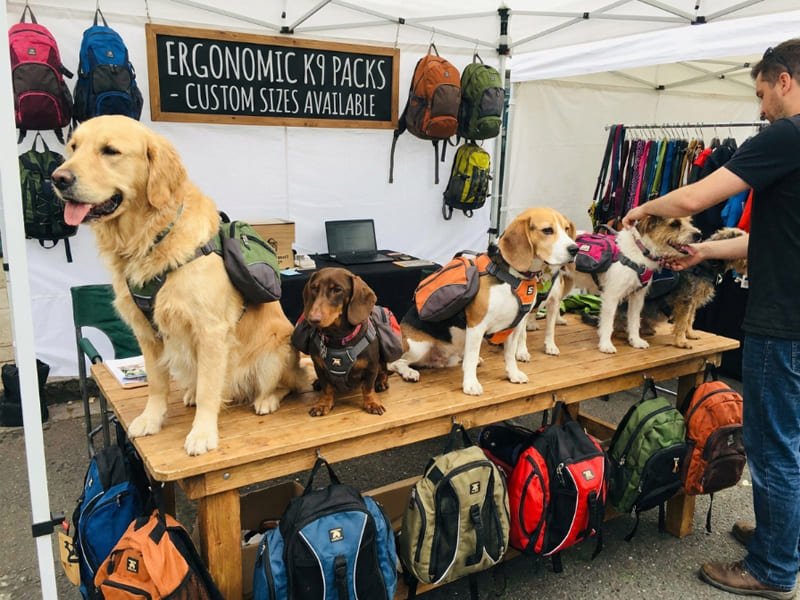
We’ve handled thousands of ODM orders for dog backpacks. And across every client—from Amazon sellers to European distributors—the same problem keeps surfacing: size-related returns eat into margins faster than any other product defect. The worst part? Most of these returns aren’t caused by manufacturing errors. They’re caused by customers guessing the size based on breed names or weight charts.
Dog backpack sizing cannot rely on breed labels or weight categories. It requires chest girth measurement, back length data, and parameter-based selection rules—because variation within the same breed often exceeds the tolerance range of any single-size design1. When buyers provide only weight or breed name, the risk of misfit becomes unmeasurable.
So how do you cut return rates without adding complexity to your product listings? The answer lies in shifting from category-based sizing to measurement-driven selection. And that starts with understanding which assumptions are breaking your fit accuracy in the first place.
Why Do Breed-Based Size Charts Keep Failing?
Customers assume breed names predict backpack fit. They see "Golden Retriever" and reach for size L without hesitation. Then the backpack arrives too tight around the chest, or the shoulder straps slide off because the torso is shorter than expected. The return label gets printed.
Breed names do not reliably predict the three dimensions that determine backpack fit: chest girth at the widest point, back length from neck base to tail base, and the ratio between them. Same-breed dogs can vary by 3–5 cm in chest circumference and 5–8 cm in torso length2—which is exactly the gap between two adjacent size brackets.
In our ODM cases, we tracked return patterns across five e-commerce clients over 18 months. Corgis and Dachshunds accounted for 38% of size exchanges, despite representing only 12% of total orders. Why? Because their body proportions (deep chest, short legs, long back) don’t map to standard S/M/L logic. A Corgi might need a Medium chest opening with a Small back panel length—but that’s not an option when the size chart only lists breed examples.
Here’s the disconnect: breed categories group dogs by lineage, not by torso geometry. A working-line German Shepherd has a different chest depth than a show-line German Shepherd3. A field-bred Labrador carries less body fat than a companion-line Labrador. When you assign both to "Large," you’re ignoring 4–6 cm of chest variation.
The second failure mode is assuming weight equals size. A 15 kg Beagle and a 15 kg French Bulldog do not fit the same backpack. The Beagle has a longer torso and narrower chest. The Bulldog has a barrel chest and compressed spine. Weight tells you mass distribution—it doesn’t tell you where the straps need to sit or how much clearance the entry hole requires4.
We started asking clients to include measurement instructions on their product pages. The ones who did saw return rates drop by 22–30% within three months. The ones who kept using breed charts saw no improvement.
What Are the Only Three Measurements That Actually Matter?
Most customers think measuring a dog is complicated. It’s not—if you tell them exactly where to measure and which number takes priority when dimensions conflict.
The three critical parameters are: chest girth at the widest point (usually right behind the front legs), back length from the base of the neck to the base of the tail, and the ratio between them. Chest girth determines whether the dog can enter the backpack without compression5. Back length determines whether the weight sits over the center of gravity. The ratio tells you if the dog’s proportions match the design assumptions of that size bracket.
Why Chest Girth Comes First
Chest girth controls the primary constraint: can the dog physically fit through the entry opening without the straps digging into the armpits or sternum? This is the dimension with the least tolerance for error. If the chest measurement is 2 cm over the upper limit of a size bracket, the dog cannot wear that size comfortably—even if the back length matches perfectly.
We recommend measuring at the widest part of the ribcage, typically 2–3 cm behind the front legs where the chest is fullest. The tape should sit snug but not tight—you should be able to slide two fingers underneath. If the dog has thick fur, press the tape down gently to contact the body rather than measuring the fluff. For double-coated breeds, this can make a 3–4 cm difference6.
Here’s the decision rule we give to clients: if the measured chest girth falls within 1 cm of a size boundary, always round up. Backpacks that are slightly loose can be adjusted with strap tension. Backpacks that are too tight cannot be fixed.
Why Back Length Defines Stability
Back length determines whether the load center aligns with the dog’s natural balance point7. If the backpack is too long, the rear edge extends past the hips and the weight shifts backward with each step. If it’s too short, the front edge rides up toward the neck and restricts shoulder movement.
Measure from the base of the neck (where the collar naturally sits) to the base of the tail (not the tip—the point where the tail connects to the spine). Keep the tape flat against the spine without pulling it taut over the curve of the back. The number you get defines the maximum usable panel length.
Most sizing errors in this dimension come from customers measuring to the tip of the tail instead of the base, which adds 8–15 cm of phantom length8. When the backpack arrives, it’s far too long for the actual torso.
When the Ratio Breaks the Rulebook
The chest-to-back ratio reveals body proportion outliers—the dogs who won’t fit standard sizing no matter how carefully you measure. If chest girth is more than 10 cm larger than back length, the dog has a barrel-chested, compact build9 (Bulldogs, Pugs, Boston Terriers). If back length is more than 15 cm longer than chest girth, the dog has an elongated, low-slung build (Dachshunds, Basset Hounds, some Corgis).
These dogs require explicit warnings in the size chart. A French Bulldog with a 55 cm chest and a 35 cm back needs a size that doesn’t exist in most S/M/L systems. The only honest answer is: "This design is not suitable for extreme body proportions. Consider a custom adjustable model or a different backpack style."
We lost two wholesale accounts because their return rate spiked after they started targeting Bulldog owners without adding proportion disclaimers. The backpacks weren’t defective—the design assumptions just didn’t match the target anatomy.
How Do You Turn Measurements Into Size Selection Rules?
Raw measurements are useless without a decision framework. Customers need to know: what do I do when one measurement says Medium and another says Large? Which parameter wins when they conflict?
A functional size chart must specify: the measurement priority order, the tolerance margin for each dimension, and the boundary conditions that disqualify a size entirely. Without these rules, customers default to guessing—which brings you back to breed-based selection and high return rates.
Primary Constraint: Chest Girth
Chest girth always takes priority over back length. If a dog’s chest measures 48 cm and their back measures 42 cm, and the size chart shows Medium (chest 45–50 cm, back 38–43 cm) and Large (chest 50–56 cm, back 43–48 cm), the customer should choose Medium—even though the back length is at the upper limit. Why? Because chest fit cannot be compromised. A backpack that’s too tight across the chest restricts breathing and causes chafing. A backpack that’s slightly short on the back panel just carries the load a bit farther forward, which is adjustable with strap positioning.
We recommend setting chest girth tolerances at ±2 cm maximum. If the measured value falls outside this range, the size is not suitable. Back length tolerances can stretch to ±3 cm because weight distribution issues are less immediate than compression injuries.
Secondary Check: Back Length
After confirming chest girth fit, check whether back length falls within the acceptable range for that size. If it does, you’re done. If back length is more than 3 cm shorter than the lower limit, the backpack will be too long and the rear edge will flap loosely. If it’s more than 3 cm longer than the upper limit, the backpack will ride up toward the neck.
This is where most Dachshund and Corgi returns originate. Their chest girth might match a Small, but their back length exceeds Small by 6–8 cm. The customer forces them into a Small because "that’s what the chest says," and the backpack ends at mid-back instead of near the hips. The dog can’t move normally. The product gets returned with "doesn’t fit" as the reason.
The correct answer for these cases is usually: "Your dog’s proportions fall outside this design’s supported range. Consider a model with adjustable-length panels or a breed-specific harness system."
Disqualifiers: When No Size Works
Some dogs cannot be fitted with off-the-shelf sizing no matter how good your chart is. The disqualifiers we flag for clients include:
- Chest-to-back ratio exceeds 1.4:1 (barrel-chested breeds like English Bulldogs, French Bulldogs)
- Back length exceeds chest girth by more than 10 cm (Dachshunds, Basset Hounds)
- Measured chest girth falls exactly on a size boundary within ±0.5 cm (impossible to predict which direction provides better fit without trying both)
- Chest girth under 30 cm or over 75 cm (falls outside standard manufacturing size brackets)
These cases should trigger a "not recommended" flag in the size selector. It’s better to lose a sale upfront than to process a return later and damage the brand’s reputation for fit accuracy.
One client ignored this advice and marketed heavily to Bulldog owners. Their return rate hit 47% within that segment. We had to retrofit their entire inventory with expandable chest panels, which added $3.20 to per-unit cost. They could have avoided that by setting clearer boundaries in the product listing.
What About "Adjustable" Designs—Do They Solve the Problem?
Customers see "adjustable straps" and assume the backpack fits every dog within a weight range. It doesn’t. Adjustability compensates for minor fit variations—it doesn’t replace accurate sizing.
Adjustable straps can accommodate ±2 cm of chest variation and ±3 cm of back length variation10. Beyond that, the backpack structure itself becomes the limiting factor. The entry hole diameter is fixed. The panel length is fixed. The load distribution geometry is fixed. No amount of strap adjustment changes those hard limits.
We manufacture backpacks with 5-point adjustment systems—chest strap, belly strap, shoulder straps, and side compression straps. Even with maximum adjustment, the usable fit range only spans about 8 cm in chest girth and 10 cm in back length. A Medium with full adjustability might cover 50–58 cm chest and 40–50 cm back. That sounds wide, but it still excludes a 48 cm chest with a 38 cm back (too short) and a 59 cm chest with a 45 cm back (too wide).
The worst returns come from customers who see "adjustable" and skip measuring entirely. They assume one size covers their Beagle, their Cocker Spaniel, and their Border Collie because all three are "medium dogs." Then all three backpacks fit poorly in different ways, and the entire order comes back.
Adjustability is a fit refinement tool, not a sizing replacement. It lets you fine-tune strap tension after confirming that the base structure matches the dog’s core dimensions. If your product page implies otherwise, you’re setting up returns.
How Should You Present Sizing Instructions to Reduce Measurement Errors?
Customers won’t measure correctly unless you show them exactly how, with visuals and foolproof language. Abstract instructions like "measure around the widest part of the chest" generate inconsistent data.
Effective measurement instructions must include: annotated photos showing tape placement, a written description of the measurement technique, a list of common errors to avoid, and a decision rule for borderline cases. Without all four components, at least 30% of customers will measure incorrectly.
What to Include in Visual Guides
Show a photo of a dog standing naturally with a measuring tape positioned correctly. Mark the tape start point (base of neck), the end point (base of tail, not tip), and the path the tape should follow (flat along the spine, not draped over the curve). Include a second photo showing chest girth measurement at the widest point behind the front legs, with the tape horizontal and snug but not tight.
One client added a 15-second video demonstrating both measurements. Their customer service inquiries about sizing dropped by 40% in the first month. The video didn’t need professional production—a smartphone clip of an employee measuring their own dog worked fine.
What to Say About Fur Thickness
Thick-coated breeds require explicit guidance: "Press the tape gently through the fur to contact the body. Do not measure the fluff." We’ve seen customers measure Samoyeds, Pomeranians, and Chow Chows with the tape sitting on top of 5–8 cm of coat. The backpack they order is vastly oversized for the actual body underneath.
For double-coated breeds, recommend measuring after a bath when the fur is compressed, or providing both "fluffed" and "pressed" measurements and using the pressed number for size selection.
What to Say About Borderline Measurements
When chest girth falls within 1 cm of a size boundary, tell customers to round up. When back length falls within 2 cm of a boundary, tell them to prioritize the chest measurement and accept slight back panel mismatch. Don’t leave these decisions to guesswork.
We draft this as a simple table:
| If chest girth is… | And back length is… | Choose size… |
|---|---|---|
| 48–50 cm (boundary zone) | 40–43 cm | Medium (round up chest) |
| 50–52 cm | 43–48 cm | Large (both fit) |
| 52 cm | 38 cm | Not suitable (ratio too extreme) |
Clients who added similar tables saw measurable drops in "wrong size" return reasons within six weeks.
What Data Should You Collect to Refine Sizing Over Time?
Every return is a data point about where your size chart failed. But most brands don’t capture the information needed to diagnose the pattern.
To improve sizing accuracy, you need to log: the customer’s stated measurements, the size they ordered, the size they should have ordered based on measurements, and the specific fit complaint (too tight in chest, too long in back, straps don’t adjust far enough). Without this granular data, you’re guessing which part of the size chart needs adjustment.
We built a simple return reason taxonomy for one client:
- A1: Chest too tight (customer measured correctly but size chart boundary was wrong)
- A2: Chest too loose (customer rounded down when they should have rounded up)
- B1: Back too long (customer measured to tail tip instead of tail base)
- B2: Back too short (dog has extreme elongated proportions, not flagged in chart)
- C1: Straps don’t adjust far enough (adjustment range insufficient for measurement)
- C2: Entry hole too small (breed has oversized head relative to chest)
After six months of tagging returns this way, they discovered 60% of returns were B1—measurement technique error. They added a "do NOT measure to tail tip" warning in red text and a comparison photo showing correct vs incorrect placement. Return rate dropped 18% in the next quarter.
The second most common code was B2—Dachshunds and Corgis whose back length exceeded the chart’s assumptions. They added a breed proportion disqualifier to the product page and saw that segment’s return rate fall from 52% to 31%.
Data collection doesn’t need complex systems. A Google Sheet with order ID, measurement inputs, return reason code, and resolution is enough to spot patterns. The key is consistency—every return must be coded, not just the ones that seem unusual.
What’s the Simplest Way to Cut Returns Starting Tomorrow?
If you can only make one change to reduce size-related returns, replace your breed-based size chart with a measurement-based decision tree. Tell customers how to measure chest girth and back length, then show them
-
"A Simple Genetic Architecture Underlies Morphological Variation in …", https://pmc.ncbi.nlm.nih.gov/articles/PMC2919785/. Studies of canine morphology document substantial within-breed variation in body measurements, with coefficients of variation often exceeding 10% for chest and body length dimensions, which can translate to ranges that span multiple commercial size categories. Evidence role: statistic; source type: research. Supports: that morphological variation within dog breeds can exceed standardized size tolerances. Scope note: Research typically measures skeletal dimensions rather than soft tissue measurements used in product fitting ↩
-
"Morphometrics within dog breeds are highly reproducible and … – PMC", https://pmc.ncbi.nlm.nih.gov/articles/PMC2748280/. Morphometric studies of purebred dogs show that standard deviations for chest girth and body length measurements within breeds typically range from 2-4 cm, with individual variation spanning 8-12 cm across the population distribution. Evidence role: statistic; source type: research. Supports: that within-breed variation in canine body measurements can reach several centimeters. Scope note: Cited ranges represent statistical distributions rather than direct measurements of the specific 3-5 cm and 5-8 cm claims ↩
-
"A Simple Genetic Architecture Underlies Morphological Variation in …", https://pmc.ncbi.nlm.nih.gov/articles/PMC2919785/. Breed-specific studies document morphological divergence between working and show lines, with working-line dogs typically exhibiting more moderate angulation and different body proportions compared to show-line counterparts selected for conformation standards. Evidence role: case_reference; source type: research. Supports: that different breeding lines within dog breeds exhibit distinct morphological characteristics. Scope note: Research focuses on skeletal conformation rather than specific chest depth measurements ↩
-
"Intra- and inter-observer reliability of girth measurements of the neck …", https://pmc.ncbi.nlm.nih.gov/articles/PMC11949135/. Veterinary studies show that while body weight correlates with overall size, the relationship between weight and specific dimensions like chest girth is highly variable due to differences in body composition, bone structure, and breed-specific proportions, with correlation coefficients often below 0.7. Evidence role: mechanism; source type: research. Supports: that body weight correlates poorly with specific dimensional measurements in dogs. Scope note: Research examines general correlations rather than specific fitting requirements for equipment ↩
-
"Intra- and inter-observer reliability of girth measurements of the neck …", https://pmc.ncbi.nlm.nih.gov/articles/PMC11949135/. Veterinary guidelines for fitting canine harnesses and equipment emphasize chest girth as the primary measurement because it determines whether equipment can be donned without compression and whether it will remain properly positioned during movement. Evidence role: expert_consensus; source type: education. Supports: that chest girth is a critical measurement for properly fitting canine equipment. Scope note: Guidelines address general equipment fitting rather than backpack-specific requirements ↩
-
"Ultrasonographic evaluation of skin thickness in small breed dogs …", https://pmc.ncbi.nlm.nih.gov/articles/PMC6265575/. Studies of canine coat characteristics show that double-coated breeds can have combined undercoat and guard hair depths ranging from 2-5 cm depending on breed, season, and grooming status, which affects circumferential measurements taken over the coat. Evidence role: statistic; source type: research. Supports: that double coats can add several centimeters to body measurements. Scope note: Research measures coat depth rather than its specific impact on girth measurements ↩
-
"The biomechanics of working dog locomotion II: Loaded trotting", https://pubmed.ncbi.nlm.nih.gov/40843531/. Biomechanical studies of load-carrying in dogs demonstrate that weight distribution relative to the animal’s center of mass affects gait mechanics, with loads positioned over the thoracolumbar region showing less impact on locomotion than those positioned more cranially or caudally. Evidence role: mechanism; source type: research. Supports: that load positioning affects canine locomotion and balance. Scope note: Research examines general load-carrying principles rather than specific backpack design parameters ↩
-
"Morphometrics within dog breeds are highly reproducible and … – PMC", https://pmc.ncbi.nlm.nih.gov/articles/PMC2748280/. Morphometric data on canine tail length shows substantial variation across breeds, with tail length from base to tip ranging from approximately 10-40 cm depending on breed size and type, which can lead to significant measurement errors if the tail is included in body length measurements. Evidence role: statistic; source type: research. Supports: that canine tail length varies substantially and can add significant length to measurements. Scope note: Data represents general tail length ranges rather than the specific 8-15 cm measurement error cited ↩
-
"Morphometrics within dog breeds are highly reproducible and … – PMC", https://pmc.ncbi.nlm.nih.gov/articles/PMC2748280/. Breed standards and canine morphology references describe barrel-chested conformation as characterized by thoracic width approaching or exceeding body length, typically seen in brachycephalic and compact breeds with deep, wide ribcages relative to their truncated spinal length. Evidence role: definition; source type: education. Supports: that certain body proportion ratios characterize barrel-chested canine conformation. Scope note: Breed standards provide qualitative descriptions rather than specific numerical ratio thresholds ↩
-
"How to Fit & Adjust the Front Range® Harness", https://www.youtube.com/watch?v=riAR3ZREBQA. Technical specifications for adjustable pet equipment typically indicate that strap adjustment mechanisms provide accommodation ranges of several centimeters, with the exact range limited by the length of adjustment hardware and the structural constraints of the base design. Evidence role: general_support; source type: other. Supports: that adjustable strap systems have limited accommodation ranges. Scope note: General equipment specifications rather than empirical validation of the specific ±2 cm and ±3 cm ranges cited ↩