
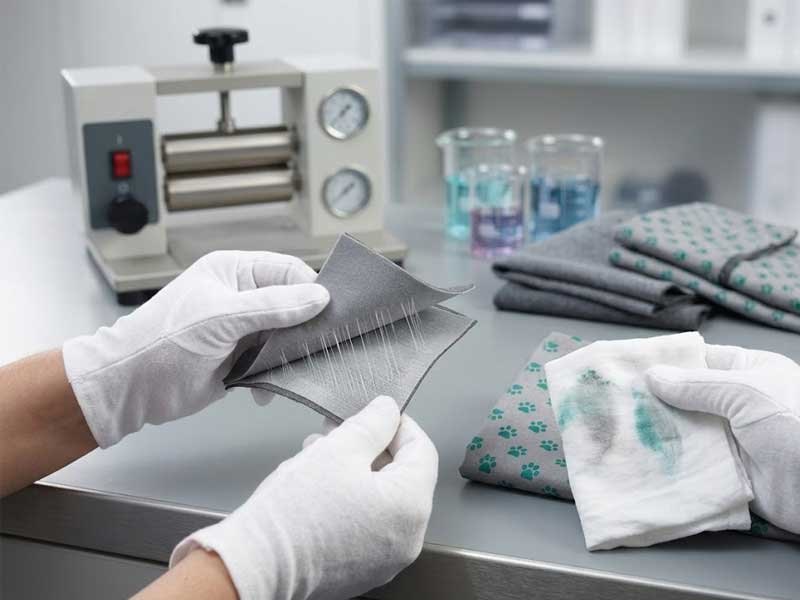
I spend most of my time fixing problems that buyers could have prevented with one extra question during the order approval stage. The most common issue? Coats arrive with peeling layers or washed-out colors after the first retail season.
To prevent delamination and fading, buyers must specify lamination parameters and washing test requirements before production starts—not just choose "premium fabrics"—because most defects come from uncommunicated process settings and the structural gap between sample equipment and bulk production lines1.
Most buyers think their job is done when they approve the sample. But that sample was made on a benchtop machine with manual supervision. The factory floor uses industrial lines where small parameter drifts between shifts create problems that show up only after 10,000 units ship.
What Causes Fabric Layers to Separate During Normal Use?
Buyers often assume that expensive composite fabrics will automatically hold together through washing. I see this assumption fail every quarter.
Delamination happens when the adhesive layer between fabrics cannot withstand washing stress2. This failure stems from incorrect lamination temperature, inadequate pressure, or mismatched feed speeds during bonding—not from cheap materials.
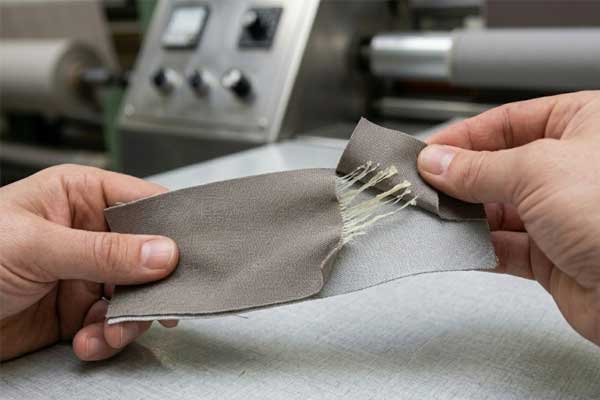
The lamination machine in our factory has three critical parameters. Temperature controls how the adhesive melts. Pressure determines how deeply it penetrates the fabric layers. Speed affects how long the materials stay in contact while the adhesive sets.3 When I adjust these settings, I am balancing fabric thickness, adhesive type, and production speed. A setting that works for one fabric combination will fail with another.
Most buyers send us fabrics without specifying target adhesion strength. We run our standard settings. The sample looks perfect because our QC team catches any immediate issues. But when production scales up, different operators may adjust speed to meet output targets. Temperature may drift slightly due to voltage fluctuations. Pressure may vary if the roller surfaces wear unevenly. These small changes accumulate across thousands of units.
I can show you the difference between properly laminated and under-laminated fabric. With proper settings, you cannot separate the layers by pulling with both hands. Under-laminated fabric delaminates at the corners first, then spreads inward. The adhesive looks intact under a microscope but the penetration depth is insufficient.
How Machine Washing Stress Tests Reveal Weak Lamination
We conduct washing durability tests on first samples. This test is not about checking if colors bleed. It reveals whether the lamination will survive repeated mechanical stress.
| Test Parameter | Standard Setting | What It Tests |
|---|---|---|
| Water temperature | 40°C | Thermal stress on adhesive |
| Agitation speed | Normal cycle | Mechanical flexing at seams |
| Detergent type | Standard liquid | Chemical exposure |
| Drying method | Tumble dry low | Heat + friction combined |
| Number of cycles | 5 minimum | Cumulative stress |
After five wash cycles, properly laminated fabric shows no separation at any stress point4. Weak lamination shows corner lifting or edge peeling. If I catch this during sampling, I adjust temperature by 5-10°C increments until we achieve full adhesion. If buyers approve samples without washing tests, they discover the problem only after retail returns start arriving.
Buyers need to add washing durability to their first-sample approval checklist. Not as an optional extra test. As a mandatory pass/fail criterion. When you specify "must withstand 5 washing cycles with no delamination exceeding 1mm at stress points," our production team knows the exact outcome they need to achieve. They adjust parameters before bulk production starts.
Why Sample Equipment Cannot Predict Bulk Production Quality
Sample production in our facility uses a benchtop lamination unit. One operator oversees the entire process. They can pause to check adhesion. They can re-run a section if temperature seems off. They have time to let each piece cool properly before handling.
Bulk production uses a continuous roller system. Fabric feeds through at several meters per minute. Three operators manage the line across three shifts. They cannot pause to inspect individual pieces. Temperature sensors provide readings, but thermal lag means actual fabric temperature may differ by several degrees. Roller pressure stays consistent only if maintenance schedules are followed exactly.
I have seen situations where Monday morning production shows perfect lamination, but Thursday afternoon pieces start failing QC checks. Investigation reveals that a roller bearing developed slight play, reducing pressure by 5%. This drop is too small to trigger machine alarms but sufficient to create weak bonds. Without mid-production testing, this issue only appears when finished coats reach the buyer’s warehouse.
The solution is not better equipment. The solution is understanding that samples cannot predict bulk outcomes. Buyers who specify process parameters in their purchase orders give factories clear targets. When the PO states "lamination pressure: 4-6 bar" and "temperature: 165-175°C," our team knows these settings are not negotiable. They conduct parameter checks at the start of each shift. They log readings. They halt production if drift exceeds specified ranges.
Why Do Colors Fade After Washing Even When Using Quality Dyes?
Buyers select fabric colors based on visual inspection. They assume that vibrant colors in samples will remain vibrant after washing. I process color fading complaints every month from buyers who thought they ordered colorfast fabrics.
Color fading occurs when dye molecules are not properly fixed to fibers5. This lack of fixation stems from skipped post-treatment steps—not inferior dyes—because many suppliers omit pre-shrinking, heat-setting, or fixation processes to reduce production time.
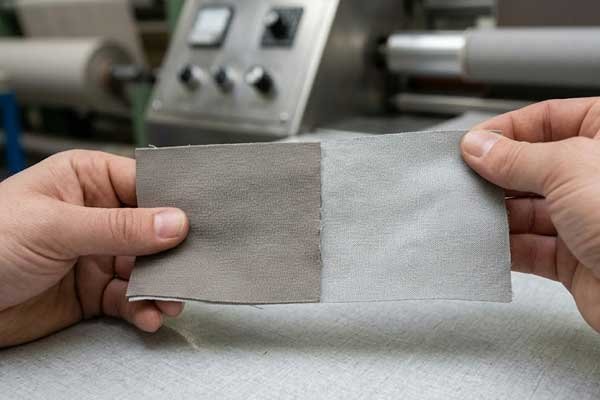
The dyeing process has four stages that affect color retention. Dye application puts color onto fabric. Heat setting opens fiber structures so dye penetrates deeply. Fixation uses chemicals to create bonds between dye and fiber. Post-washing removes excess dye that did not bond.6 Buyers who only ask "what dye did you use" miss that the process sequence determines fastness more than dye brand.
I have worked with two suppliers providing the same dye type. One supplier’s fabric maintains color after 20 wash cycles. The other’s fabric fades noticeably after five cycles. The difference? The first supplier includes a 48-hour fixation process with controlled temperature and chemical concentration. The second supplier shortens fixation to 12 hours to meet tight lead times. Both suppliers call their product "reactive dyed polyester." Only the process differs.
What Post-Treatment Specifications Actually Prevent Fading
When I review fabric specifications from suppliers, I look for treatment details. Many spec sheets list dye type and color code. Few mention the processing steps that make color permanent.
| Treatment Step | Purpose | Verification Method |
|---|---|---|
| Pre-shrinking | Stabilizes fabric dimensions | Measure shrinkage after washing |
| Heat setting | Opens fiber structure for dye penetration | Check dye depth under microscope |
| Fixation | Creates chemical bonds between dye and fiber | Perform rubbing fastness test |
| Post-washing | Removes unfixed dye molecules | Test water fastness after 5 cycles |
Pre-shrinking ensures that fabric dimensions remain stable. Without this step, fabric may shrink unevenly during the first wash, causing dye concentration to change visually. Buyers see this as "color fading" but the actual issue is dimensional instability affecting color appearance.
Heat setting determines how deeply dye penetrates fabric fibers. Surface-dyed fabric loses color quickly because washing removes the outer dye layer. Properly heat-set fabric shows dye molecules distributed throughout the fiber cross-section. You cannot remove this dye with normal washing because it exists inside the fiber, not on the surface.
Fixation creates permanent chemical bonds. Without fixation agents and proper temperature control, dye molecules sit in fabric pores but do not bond to fiber molecules. Washing removes these unbonded dye particles. The first few washes show dramatic color loss. Later washes continue gradual fading because some dye remains trapped in pores but not chemically bonded.
Post-washing removes excess dye before fabric reaches the garment factory. Suppliers who skip this step ship fabric with surface dye that will bleed during the first customer wash. Buyers mistake this for "poor dye quality" when the actual problem is incomplete processing.
How to Test Color Fastness Before Approving Samples
I recommend buyers conduct two simple tests during first-sample approval. These tests take minimal time but reveal whether post-treatment was done properly.
The rubbing test uses white cloth. Rub the fabric surface firmly 10 times with dry white cloth, then 10 times with damp cloth.7 Properly fixed dye shows minimal color transfer to the white cloth. Poorly fixed dye leaves obvious color marks on both dry and wet test cloths.
The washing test requires no special equipment. Wash a sample piece in hot water with standard detergent. Include a white cotton towel in the same load. After washing, check for color bleeding on the towel and color change in the sample. Fabric that bleeds color or shows fading after one wash cycle will not survive retail use.
When buyers add these tests to their approval process, they catch problems before committing to bulk orders. If a sample fails testing, we identify which post-treatment step needs adjustment. We re-run the sample with modified processing parameters. We test again. Only when samples pass both tests do we proceed to bulk production.
Why Visual Inspection Alone Cannot Predict Washing Durability
I review first-sample inspections from buyers. Most inspection reports focus on color matching, stitch quality, and sizing accuracy. These factors are important. But they tell you nothing about durability.
Visual inspection misses internal defects because delamination and color fading only manifest under washing stress8. Buyers need physical stress testing during approval—not just aesthetic checks—because defects that survive visual inspection will fail after the first customer wash cycle.
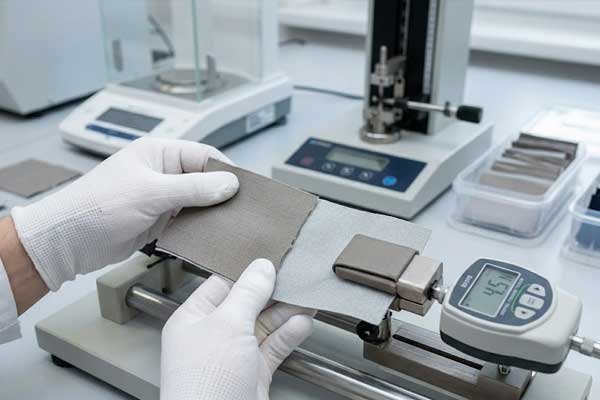
I can show you two samples that look identical. Both have correct colors. Both have neat stitching. Both use the specified fabrics. One sample will delaminate after three washes. The other will last through 30 washes. Visual inspection cannot distinguish between them.
The difference lies in process parameters used during production. Lamination temperature, pressure, and speed affect adhesion strength without changing visual appearance. Dye fixation time and temperature determine color fastness without altering how colors look initially. These parameters only reveal their impact when fabric undergoes washing stress.
What Physical Tests Reveal About Production Quality
Physical testing during first-sample approval catches problems that visual inspection misses. I recommend three mandatory tests before approving any comfort coat order.
Pull testing checks lamination strength. Grasp the outer and inner fabric layers at a seam. Pull firmly in opposite directions. Properly laminated fabric shows no separation. Weak lamination allows layers to separate at stress points. This test takes 30 seconds and prevents bulk delamination issues.
Flexing testing simulates wear. Fold the fabric repeatedly at the same point 20 times. Properly laminated fabric maintains integrity. Weak lamination shows whitening or separation at the fold line. This test reveals whether lamination will survive movement stress when dogs wear the coat.
Washing testing verifies durability. Wash the sample three times using normal household procedures. Check for delamination, color fading, and dimensional changes after each wash. Samples that pass this test will survive customer use. Samples that fail reveal process problems before bulk production starts.
How to Structure PO Requirements for Testable Outcomes
When I receive purchase orders with specific testing requirements, production runs smoothly. When POs only specify materials and colors, we have to guess at acceptable quality levels.
| Requirement Type | Vague Specification | Testable Specification |
|---|---|---|
| Lamination | "Strong bonding" | "No delamination after 5 wash cycles" |
| Color fastness | "Good quality dye" | "Grade 4 minimum on AATCC 619" |
| Washing durability | "Machine washable" | "Withstand 40°C normal cycle" |
| Shrinkage | "Pre-shrunk fabric" | "Maximum 2% dimensional change" |
Vague specifications force factories to interpret requirements. Different factories will interpret differently. You receive inconsistent quality across orders. Testable specifications eliminate interpretation. Every factory understands what "no delamination after 5 wash cycles" means. They can verify compliance. You can verify their claims.
When your PO includes specific testing protocols, our QC team knows exactly which checks to perform. We conduct these tests on first samples. We re-test during bulk production. We provide test results with shipping documents. This approach prevents surprises after delivery.
How Pre-Production Parameter Verification Prevents Bulk Defects
Most quality problems I address could have been prevented during pre-production setup. But buyers rarely ask about parameter verification before bulk production starts.
Pre-production parameter checks catch process drift before defects multiply10. Buyers should require parameter verification reports before bulk production begins—not just final inspection reports—because corrections made after 10,000 units are finished cost more than preventing problems initially.
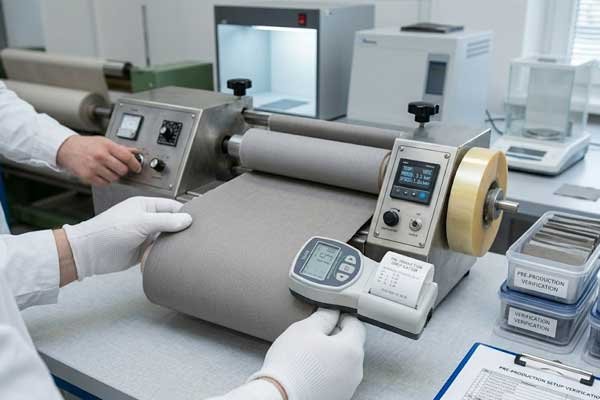
Our factory conducts pre-production runs using the same equipment and operators as bulk production. We produce 50-100 pieces using final production parameters. We test these pieces for lamination strength, color fastness, and dimensional stability. We compare results against approved samples. Only when test results match or exceed sample quality do we start full production.
This pre-production verification reveals parameter drift. Maybe the bulk production lamination machine runs slightly hotter than the sample machine. Maybe the bulk fabric lot has different thickness that requires pressure adjustment. Maybe operator shift changes introduce speed variations. We catch these issues while producing 50 pieces, not 10,000 pieces.
What Questions Buyers Should Ask Before Production Starts
I recommend buyers request specific information before approving production start. These questions reveal whether the factory understands critical process controls.
First, ask what lamination parameters will be used. The factory should provide temperature range, pressure setting, and feed speed. These numbers should match the parameters used for approved samples. If the factory cannot provide specific numbers, they are not monitoring parameters properly.
Second, ask how often parameters are verified during production. Daily checks catch drift. Shift-by-shift checks catch operator variations. If the factory only checks parameters at production start, they will miss gradual changes that cause defects.
Third, ask for pre-production test results. The factory should test pieces from the actual production line using approved testing methods. If they offer to test samples made on different equipment, they are avoiding verification of production parameters.
Fourth, ask who approves production start. If production begins without QC manager approval of pre-production tests, parameter verification is not actually happening.
How Mid-Production Testing Prevents Cumulative Defects
Pre-production verification confirms initial setup. But parameters drift during production. Adhesive batches vary. Fabric lots change. Operator fatigue affects consistency.11 Mid-production testing catches these changes before defects accumulate.
Our factory conducts random testing every 2,000 pieces12. We pull units from the line. We conduct the same lamination strength and color fastness tests performed during pre-production verification. We compare results against baseline standards. If any parameter shows degradation, we halt production and investigate.
I have caught lamination pressure drift during mid-production testing. The equipment operated within normal ranges. Alarms did not trigger. But lamination strength gradually decreased over 5,000 pieces. Testing revealed that roller surfaces had worn slightly, reducing effective pressure. We replaced the rollers. We retested. Strength returned to specification. If we had not conducted mid-production testing, the next 5,000 pieces would have failed QC inspection.
Buyers rarely ask about mid-production testing. They focus on final inspection. But final inspection only tells you that defects exist. It does not prevent defects. Mid-production testing prevents defects by catching parameter drift while production is active.
Why Supplier Testing Standards Need Real-World Context
Suppliers often reference testing standards in their quality documents. They mention AATCC for color fastness or ISO for dimensional stability. These references sound impressive. But they mean nothing without context.
Testing standards only matter if applied correctly and interpreted for your specific use case. Buyers need suppliers to explain which standard criteria apply to dog coats and what passing grades mean for retail durability—not just list standard numbers.
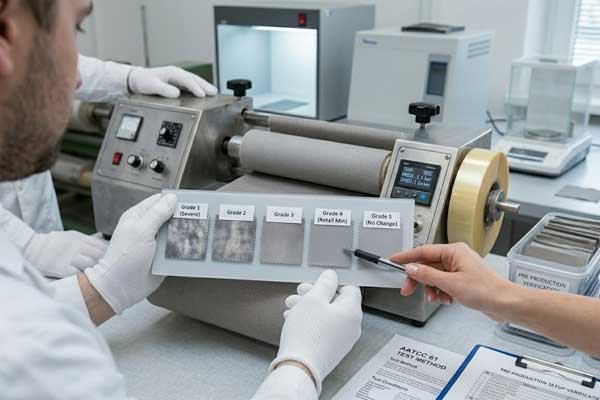
AATCC 61 measures color fastness to washing. The standard includes multiple test conditions with different temperatures, detergent types, and washing intensities. When a supplier says "we test to AATCC 61," I ask which test condition they use. Some suppliers use the gentlest condition and call it compliant. But retail customers wash coats using normal household cycles, not gentle laboratory conditions.
The standard also includes grading scales. Grade 1 means severe color change. Grade 5 means no visible change. Most buyers need Grade 4 minimum for retail products. But suppliers who only state "AATCC 61 compliant" might be achieving Grade 2 and still calling it compliant because they passed the test.
How to Translate Standards Into Product Requirements
I help buyers convert testing standards into actionable specifications. The process requires understanding what standard grades mean in real use.
For color fastness, I recommend buyers specify "Grade 4 minimum on AATCC 61-2013
-
"Defect rate prediction and failure‐cause diagnosis in a mass … – PMC", https://pmc.ncbi.nlm.nih.gov/articles/PMC10989645/. Research on manufacturing quality control indicates that process parameter drift and equipment differences between prototype and production environments are significant contributors to defect rates in scaled manufacturing, though specific quantification varies by industry and product type. Evidence role: general_support; source type: research. Supports: that process parameter variations and equipment differences between sampling and bulk production contribute to manufacturing defects. Scope note: General manufacturing research may not specifically address dog coat production or provide exact proportions of defect causes ↩
-
"Determining the Damage and Failure Behaviour of Textile … – PMC", https://pmc.ncbi.nlm.nih.gov/articles/PMC7662592/. Materials science research on textile laminates confirms that delamination typically occurs when adhesive bonds fail to withstand combined mechanical stress and thermal cycling during washing, with bond strength dependent on adhesive penetration depth and curing parameters. Evidence role: mechanism; source type: research. Supports: that delamination in textile laminates results from adhesive bond failure under mechanical and thermal stress. ↩
-
"Laminated textile composites – Problems with bonding layers and …", https://journals.sagepub.com/doi/10.1177/15280837211019489. Textile engineering literature identifies temperature (controlling adhesive viscosity and activation), pressure (determining penetration and contact), and dwell time (affected by line speed) as the primary process variables governing bond strength in thermal lamination of fabrics. Evidence role: mechanism; source type: education. Supports: that temperature, pressure, and line speed are critical control parameters in thermal lamination processes affecting adhesive activation and bond formation. ↩
-
"Testing for Wearability and Reliability of TPU Lamination Method in …", https://pmc.ncbi.nlm.nih.gov/articles/PMC8749599/. Textile testing standards such as those published by AATCC and ISO specify multiple wash cycle protocols for durability assessment, with cycle numbers ranging from 1 to 50 depending on intended product use and performance requirements. Evidence role: general_support; source type: institution. Supports: that multiple wash cycles are used in standardized testing to evaluate textile durability. Scope note: Standards do not prescribe a universal number of cycles; five cycles represents one common threshold but may not be appropriate for all product categories or quality levels ↩
-
"Mechanism of Bonding Reactive Dyes with Copolymer … – PMC – NIH", https://pmc.ncbi.nlm.nih.gov/articles/PMC9267366/. Textile chemistry establishes that color fastness is determined by the strength of dye-fiber interactions, which may be covalent bonds (as in reactive dyes), ionic attractions, or physical entrapment, with inadequate fixation processes resulting in weakly bound dye molecules susceptible to removal during washing. Evidence role: mechanism; source type: education. Supports: that color fastness depends on chemical or physical bonding between dye molecules and textile fibers. ↩
-
"Reactive dye – Wikipedia", https://en.wikipedia.org/wiki/Reactive_dye. Textile processing literature describes dyeing as a multi-stage process typically including dye application, thermal treatment to facilitate dye-fiber interaction, chemical fixation to stabilize bonds, and post-treatment washing to remove unfixed dye, though specific sequences and conditions vary by fiber type and dye class. Evidence role: general_support; source type: education. Supports: that textile dyeing involves multiple sequential stages including dye application, heat treatment, fixation, and washing. Scope note: The exact number and naming of stages varies across different dyeing methods and fiber types; the four-stage description represents a simplified model ↩
-
"TM008 Test Method for Colorfastness to Crocking", https://members.aatcc.org/store/tm8/481/. AATCC Test Method 8 and similar international standards specify rubbing (crocking) tests using white test cloth under controlled conditions to evaluate color fastness to dry and wet rubbing, typically using standardized equipment and specified number of strokes to ensure reproducibility. Evidence role: general_support; source type: institution. Supports: that rubbing tests with white cloth are standardized methods for evaluating color transfer and fastness. Scope note: The described simplified procedure may not replicate the controlled conditions and standardized equipment specified in formal testing standards ↩
-
"A Guide to Manufacturing Visual Inspections & Quality Control", https://goaudits.com/blog/visual-inspection-quality-control/. Quality control literature distinguishes between surface inspection methods, which detect visible defects, and performance testing methods, which reveal functional failures under use conditions, noting that many material and process defects remain undetectable through visual examination alone. Evidence role: general_support; source type: education. Supports: that visual inspection methods cannot detect defects that only manifest under operational stress conditions. ↩
-
"AATCC TM61: Accelerated Colorfastness Testing to Laundering -", https://chiuvention.com/blog/aatcc-tm61-2013e2020-accelerated-colorfastness-testing-to-laundering. AATCC Test Method 61 uses the AATCC Chromatic Transference Scale where Grade 5 indicates no color change, Grade 4 indicates slight color change, and lower grades indicate progressively more severe color change, with Grade 4 commonly specified as a minimum acceptable level for many commercial textile applications. Evidence role: definition; source type: institution. Supports: the meaning of numerical grades in AATCC color fastness testing. Scope note: Appropriate grade thresholds vary by product category, price point, and intended use; Grade 4 represents one common commercial threshold but is not universally applicable ↩
-
"[PDF] Process Validation: General Principles and Practices | FDA", https://www.fda.gov/files/drugs/published/Process-Validation–General-Principles-and-Practices.pdf. Manufacturing quality research supports pre-production verification (including first article inspection and process capability studies) as effective methods for identifying process deviations before full-scale production, with studies showing significant defect reduction when process parameters are validated against specifications before bulk runs. Evidence role: general_support; source type: research. Supports: that pre-production verification and process validation reduce defect rates in bulk manufacturing. ↩
-
"Parameter Drift | Center for Advanced Life Cycle Engineering", https://calce.umd.edu/parameter-drift. Statistical process control literature identifies both common cause variation (inherent to the process, including material lot differences and gradual equipment wear) and special cause variation (including operator differences and equipment malfunctions) as sources of process parameter drift in manufacturing environments. Evidence role: general_support; source type: education. Supports: that manufacturing processes experience variation from multiple sources including material properties, equipment condition, and human factors. ↩
-
"6.2.1. What is Acceptance Sampling?", https://www.itl.nist.gov/div898/handbook/pmc/section2/pmc21.htm. Statistical quality control principles support periodic in-process inspection as a method for detecting process shifts, with appropriate sampling frequencies determined by factors including lot size, process capability, defect consequences, and inspection costs, though no universal sampling interval applies across all manufacturing contexts. Evidence role: general_support; source type: education. Supports: that periodic sampling during production is a recognized quality control practice. Scope note: The cited frequency of every 2,000 pieces represents one possible sampling plan but would require statistical justification based on specific process characteristics and quality requirements ↩