
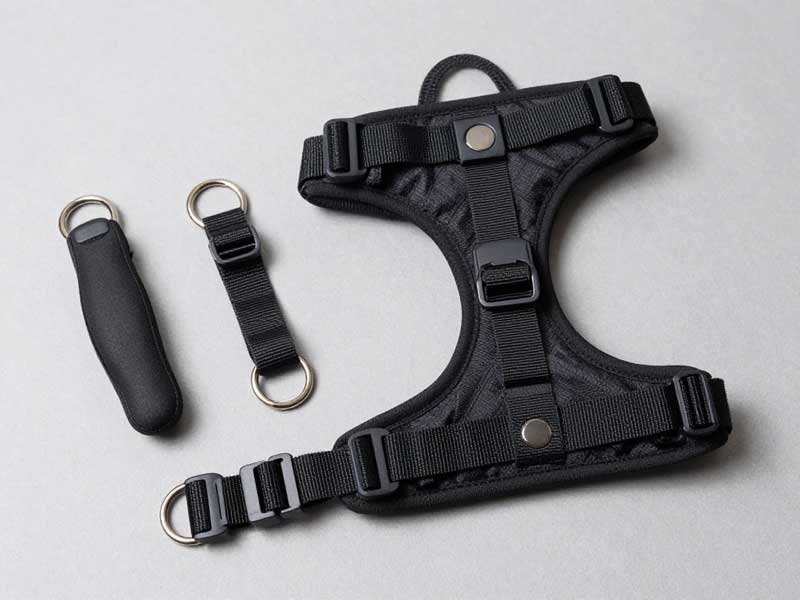
Too many brands treat harness accessories as decorative add-ons—a cute patch here, a trendy clip there—without solving the real problems their customers face during walks, training sessions, or outdoor adventures. I’ve seen this mistake repeatedly in our OEM projects: clients request visually appealing accessories that fail basic compatibility tests or don’t address actual user pain points. The result? Returns, safety concerns, and missed opportunities to differentiate their product line with genuinely useful features.
The six most functional harness accessories aren’t about aesthetics—they’re problem-solvers that address leash control, storage efficiency, visibility, training effectiveness, and structural compatibility. Selecting the right accessories requires matching attachment specifications (D-ring position, webbing width, load-bearing capacity) to specific usage scenarios, not copying competitor catalogs. Urban walking demands different accessory priorities than hiking or service work, and treating these contexts interchangeably creates product lines that serve no scenario well.
Here’s the challenge most brands face: they build accessory collections backward. Instead of asking "what problem does this solve during actual use?" they start with trending features and hope customers figure out when to use them. In our custom development projects, clients often request universal attachment systems without specifying target harness types, dog size ranges, or usage contexts—then discover during prototyping that their "versatile" design works poorly across all scenarios. This article organizes harness accessories by decision context, not product categories, so you can build a focused line that actually serves your target customers.
What Accessories Improve Leash Control During Urban Walking?
Urban walking creates specific control challenges: crowded sidewalks, sudden stops at crosswalks, close-quarters maneuvering around other pedestrians and dogs. Brands targeting city pet owners need accessories that enhance quick directional changes and prevent tangling without adding bulk to compact harnesses.
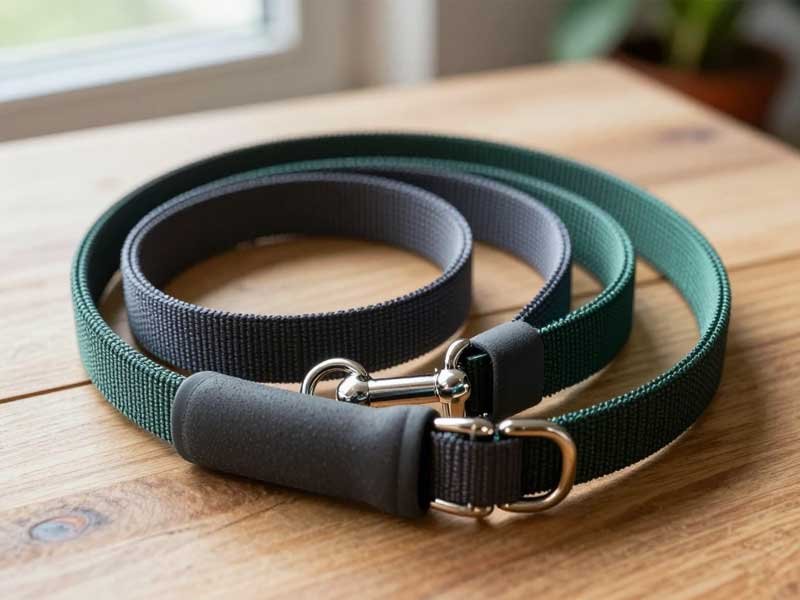
The primary leash control accessories for urban scenarios are front-attachment conversion clips and anti-twist swivel connectors. Front-attachment points redirect pulling force toward the handler rather than forward, giving better steering control in tight spaces.1 Swivel connectors prevent leash wrap-around during frequent direction changes, which is critical when navigating obstacle-dense environments like busy streets or indoor public spaces.
Front-Attachment Conversion Systems
In our manufacturing experience, brands consistently underestimate compatibility requirements for front-attachment add-ons. These accessories convert back-clip harnesses to front-clip functionality by adding a chest-positioned D-ring or attachment point. The critical spec isn’t the clip itself—it’s whether your target harness design has a chest strap with sufficient webbing width (typically 20mm minimum) and reinforced stitching to handle lateral pulling forces.
Common client mistake: specifying front-clip converters for minimalist harnesses without chest straps, or for lightweight designs that can’t distribute pulling force properly. The accessory works mechanically but creates pressure points or structural stress that leads to warranty claims. Before adding this accessory to your product line, audit your harness construction:
- Webbing gauge compatibility – Standard converters require 20–25mm webbing2; thinner straps need custom-sized hardware
- Attachment method – Slide-on designs work for straight webbing sections; sewn loops or buckle-integrated versions suit more complex strap arrangements
- Load distribution – Front pulling concentrates force differently than back pulling; harness stitching and fabric must accommodate lateral stress
If your harness line includes step-in or vest-style designs without distinct chest straps, front-clip converters won’t function properly—direct your product development toward integrated front-ring designs instead.
Swivel Connector Functions
Leash twist is an urban-specific problem that outdoor-focused brands often overlook.3 In open trail environments, dogs move relatively straight; in city blocks, they circle parking meters, navigate around café tables, and redirect constantly. Without swivel connectors, this creates rope-style leash twisting that reduces effective leash length and requires frequent untangling stops.
Swivel connectors address this mechanically with ball-bearing or rotating collar mechanisms between the leash clip and harness attachment.4 The functional requirement is smooth 360-degree rotation under load—cheaper swivels bind under tension, defeating their purpose. In our custom projects, clients typically overlook swivel load rating requirements until testing phase, resulting in redesigns.
Selection criteria for swivel connectors:
| Feature | Urban Walking Spec | Why It Matters |
|---|---|---|
| Rotation test | 50+ full rotations under 15kg load | Ensures functionality doesn’t degrade during normal walk cycles |
| Attachment width | Match harness D-ring opening (typically 12–15mm) | Oversized swivels create leverage gaps; undersized won’t fit standard rings |
| Material spec | Zinc alloy minimum (requires supplier confirmation) | Plastic housings crack under cold weather + impact stress |
| Gate mechanism | Self-locking snap gate | Prevents accidental detachment during rotation |
For brands positioning products toward apartment dwellers or dense-city pet owners, bundling a quality swivel connector with your harness—rather than selling separately—removes decision friction and directly addresses the twist problem customers encounter immediately after purchase.
Which Accessories Solve Storage Problems During Outdoor Activities?
Hiking and extended outdoor sessions create carrying challenges that urban walking doesn’t: owners need hands-free access to waste bags, treats, water bottles, and sometimes keys or phones while maintaining leash control. Brands targeting the outdoor segment need storage accessories that integrate structurally with harness designs, not decorative pouches that shift or bounce during movement.
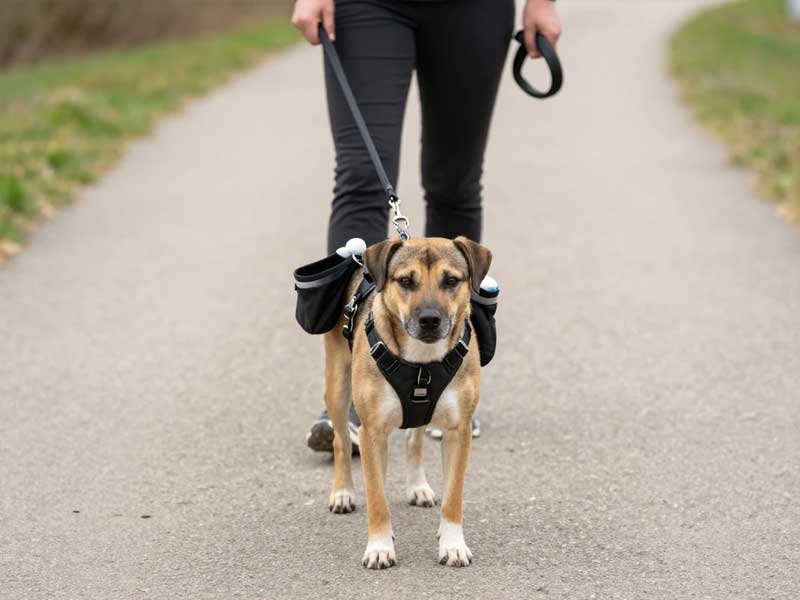
Effective outdoor storage accessories attach directly to harness load-bearing webbing and distribute weight across the dog’s body, not the handler’s hands. Saddle-bag style attachments and integrated treat pouches solve the "where do I put this?" problem that interrupts trail flow and forces owners to carry separate fanny packs or backpacks for basic supplies.
Saddle-Bag Integration Requirements
In our OEM projects, saddle-bag accessories reveal the most common compatibility miscalculation: clients design bag attachments for "universal" harness compatibility without accounting for back strap width variations, girth adjustment ranges, or D-ring placement. The result is bags that slide, tilt, or interfere with leash attachment points during actual use.
Functional saddle-bags require specific harness features:
- Parallel back straps with consistent spacing (typically 8–12cm apart) – bags attach via strap loops or buckle systems that span these straps
- Stable attachment zones behind shoulder blades and in front of hip joints – prevents shifting during movement
- Non-interference with D-ring access – bags positioned too far forward block back-clip leash attachment; too far back they swing during running
The manufacturing constraint clients usually discover late: saddle-bag weight capacity directly depends on harness structural reinforcement. A lightweight mesh harness designed for casual walking can’t support loaded saddle-bags (even 1kg total) without distorting fit or creating pressure points.5 If you’re adding saddle-bag accessories to your product line, your harness base must include:
- Reinforced stitching at bag attachment points (bar-tack or box-stitch minimum)
- 30–40mm webbing width in load-bearing zones
- Fabric panels (ripstop nylon or similar) that prevent strap-through tearing
Brands targeting serious hikers should specify expected load capacity clearly—"designed for 0.5kg per side" or similar—rather than implying unlimited capacity that creates safety liability.
Treat Pouch Positioning Logic
Quick-access treat pouches serve training scenarios more than pure transportation, but outdoor contexts (where wildlife encounters or distance rewards matter) benefit from harness-mounted options. The critical design choice: zipper-top pouches versus open-top holders.
Zipper-top advantages:
- Prevents treat spillage during running or climbing
- Keeps contents dry during light rain
- Reduces odor dispersion that attracts wildlife
Open-top advantages:
- Faster access for time-sensitive training moments
- Simpler one-handed operation with gloves
- Lower manufacturing cost and fewer mechanical failure points
From a compatibility perspective, treat pouches must attach to stable harness locations that the owner can reach without pulling or adjusting the harness. Common mounting points:
- Side strap attachment (near ribcage) – accessible while walking, doesn’t interfere with saddle-bags
- Chest strap integration – very quick access but adds bulk in front-attachment zone
- Back panel mounting – works for training scenarios where handler walks behind dog, not suitable for tight trail navigation
The manufacturing reality: pouches add another component to quality control and increase total harness assembly time. For brands with limited production runs, offering pouches as separate accessories (with clear compatibility specs) reduces inventory complexity compared to integrated designs.
How Do Visibility Accessories Enhance Safety in Low-Light Conditions?
Low-light visibility is a genuine safety concern that directly affects product liability, yet many brands approach it cosmetically rather than functionally. Clients often request "reflective trim" as an aesthetic feature without specifying retroreflective performance standards or attachment durability under weather exposure.
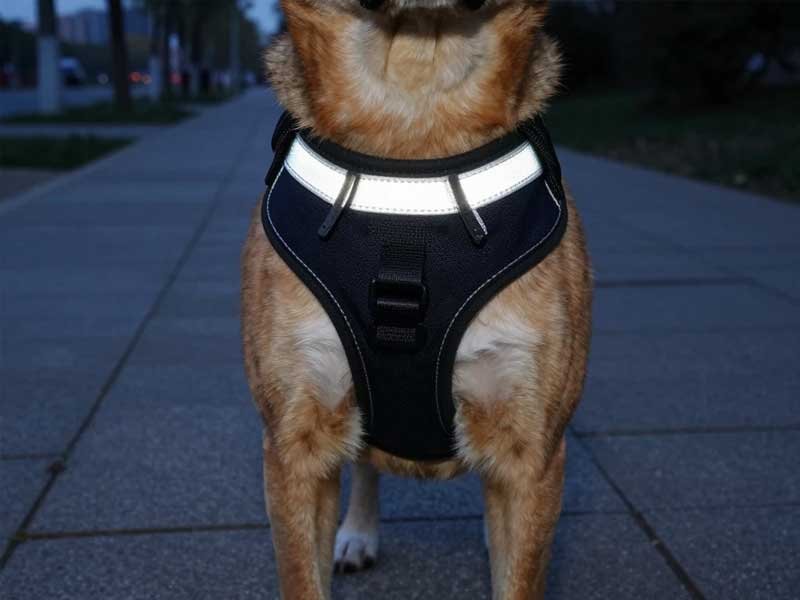
Functional visibility accessories must meet two requirements: retroreflective material that reflects light back to its source (vehicle headlights) with measurable intensity, and secure attachment methods that prevent detachment or rotation during use. Decorative glow-in-the-dark materials or standard reflective fabrics don’t provide adequate visibility at the distances drivers need to react safely.
Retroreflective Strip Specifications
In our custom development projects, "reflective" specifications vary wildly until we push clients for measurable standards. The functional question isn’t "does it reflect?"—it’s "at what distance does a driver traveling at 50km/h see the dog clearly enough to react?6"
Retroreflective performance standards (requires supplier confirmation):
- EN 13356 (European standard for visibility accessories) specifies minimum retroreflection coefficients
- ANSI/ISEA 107 (North American high-visibility standard) includes requirements for material placement and surface area
These standards don’t directly govern pet products but provide objective benchmarks. Brands serious about safety functionality should request supplier documentation showing their reflective material meets one of these standards, rather than accepting vague "reflective coating" descriptions.
Attachment durability matters equally. Sewn-on reflective strips outperform adhesive-backed or heat-sealed options in weatherproofing and wash durability. Common failure mode we see in returned samples: reflective strips that peel after 5–10 washes or delaminate during rain exposure. If your harness targets active outdoor users, specify:
- Perimeter stitching for all reflective strips (not just corner tacking)
- Weather-resistant backing material
- Placement on harness zones that don’t fold or crease during wear (folding creates cracking stress)
Visibility placement strategy: strips on the dog’s side profile (both flanks) provide visibility to drivers from multiple approach angles. Back-only placement works well for rear visibility but leaves gaps for side approaches—a critical blind spot in suburban neighborhoods with mid-block crossings.
LED Attachment Systems
LED accessories (clip-on lights or light-up strips) solve visibility problems that passive reflective materials can’t: they’re visible without external light sources, making the dog detectable to non-vehicle hazards (cyclists, runners) who don’t project strong beams. However, LED accessories introduce compatibility challenges beyond reflective strips:
Mounting method conflicts:
- Clip-on lights require stable attachment points (D-rings, webbing loops) that don’t overlap with leash or storage accessory positions
- Integrated LED strips need battery compartment space and wiring channels, requiring harness redesign rather than simple accessory addition
Power management issues:
- Replaceable battery systems (CR2032, AAA) add ongoing cost and require weather-sealed compartments
- Rechargeable systems (USB-C increasingly expected) need waterproofing and charge-indicator integration
- Runtime expectations (3+ hours minimum) affect battery size and harness weight
The manufacturing reality most brands underestimate: LED accessories multiply quality control complexity. Each unit needs electrical function testing, waterproofing validation, and battery-life confirmation—steps that don’t exist in standard harness production. For initial product lines or limited runs, we typically recommend offering high-quality clip-on LED lights as separate recommended accessories rather than integrated solutions, which preserves manufacturing focus on harness structural quality.
What Training-Specific Accessories Support Professional and Home Training Workflows?
Training contexts—whether professional service dog preparation or home-based puppy socialization—create accessory requirements completely different from walking or outdoor recreation. Brands targeting trainers or training-conscious owners need accessories that support specific behavioral protocols and training progression, not generic "multi-purpose" features.
Effective training accessories provide handlers with additional control options (multiple attachment points, traffic handles), training aids (flag tabs, handle positioning guides), or progression tools (adjustable-length attachments) that align with systematic training methods. Unlike walking accessories focused on comfort or convenience, training accessories prioritize precise control and communication.
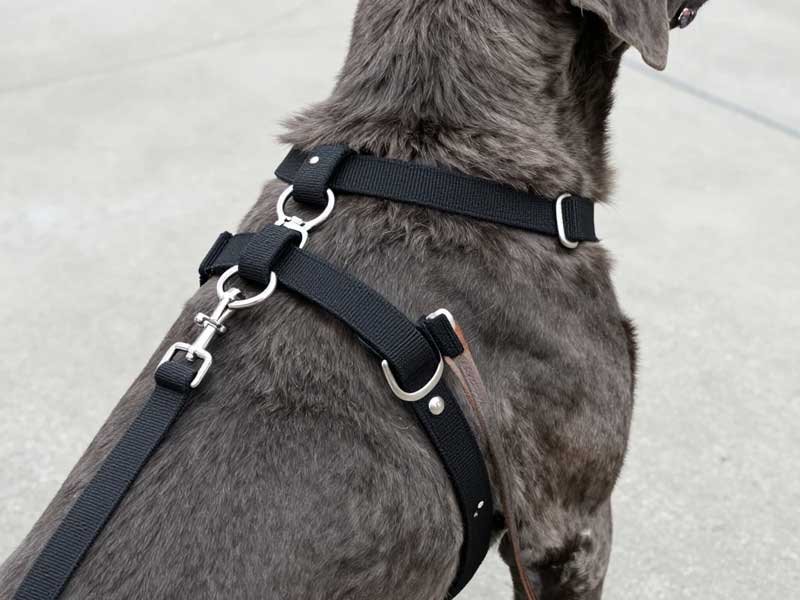
Traffic Handle Functionality
Traffic handles—short grab handles on the harness back or top—serve emergency close-control needs: crossing streets, navigating crowded doorways, preventing chase behavior toward squirrels or other dogs. In professional training contexts, they’re essential tools for impulse-control exercises and proximity training.
From a manufacturing perspective, traffic handles aren’t simple additions. Clients often spec them as "just a sewn loop on the back," but functional handles require:
Structural reinforcement:
- Attachment points must handle sudden upward pulls (30–50kg force for medium-large dogs)7
- Webbing base needs box-stitch or butterfly reinforcement—bar-tacks fail under repeated stress
- Handle position must not create pulling leverage that distorts harness fit or pulls shoulder straps downward
Ergonomic requirements:
- Handle width should accommodate adult hand grip (12–15cm internal span)
- Handle material needs padding or rounded edges—webbing alone creates hand discomfort during extended holds
- Height clearance above harness back panel (3–5cm) prevents pinching dog’s coat or skin
The compatibility issue we encounter most: clients want to add traffic handles to existing minimalist harness designs without back panels. This creates a handle that connects directly to side straps, turning it into a lifting point that concentrates all force on two narrow webbing sections. Result: strap stretching, buckle stress, and pressure distribution failure. If your harness doesn’t have a back panel or H-shape strap arrangement, traffic handles require design revision, not accessory addition.
Training-appropriate handle placement:
- Center-back position (between shoulder blades) – standard for general control, accessible when dog is in heel position
- Forward position (top of shoulders) – used in some protection training protocols, requires harness back extension
- Dual handles (shoulder and hip area) – professional service dog harnesses, requires full vest-style construction
For brands targeting the training segment, clearly document intended handle use cases (emergency control versus sustained support tasks) to help buyers select compatible harness bases.
Training Flag Tab Systems
Flag tabs—small fabric loops sewn at strategic harness points—serve as training markers and temporary attachment points for specialized equipment. Professional trainers use them for attaching training aids (target sticks, treat bags, communication devices) or marking specific handling zones for consistency across training sessions.8
This is an accessory category most consumer-facing brands overlook entirely because its value isn’t obvious without training protocol knowledge. However, brands positioning products toward professional trainers, service dog organizations, or serious working-dog applications should consider flag tab integration:
| Common flag tab positions: | Position | Training Use | Structural Requirement |
|---|---|---|---|
| Shoulder blade area | Visual marker for proper pack/vest positioning | Flat sewn loop, 5–8cm length | |
| Lower ribcage (bilateral) | Side-pack attachment or lateral control aids | Reinforced loop, load-rated for 2–5kg side pull | |
| Chest strap | Front-clip training leash transition | Must not interfere with standard D-ring access | |
| Hip/rear area | Tail-area equipment attachment (rarely used except service dogs) | Requires extended back panel |
The manufacturing advantage of flag tabs: minimal material cost and production complexity compared to functional hardware additions like handles or D-rings. They add training-specific value without complicating general-use harness functionality. For brands developing dual-purpose harness lines (everyday + training), flag tabs provide differentiation that doesn’t compromise casual user experience.
Implementation note from our projects: specify flag tab color separately from harness base color. Contrast visibility (bright tabs on dark harnesses, dark tabs on light harnesses) helps trainers quickly locate attachment points during sessions without visual searching. This detail separates thoughtfully designed training products from generic harnesses with training labels.
-
"Review of Collars, Harnesses, and Head Collars for Walking …", https://pmc.ncbi.nlm.nih.gov/articles/PMC12345489/. Studies on canine harness biomechanics indicate that front-attachment points redirect forward pulling force laterally toward the handler, creating a turning moment that reduces the dog’s ability to maintain straight-line pulling compared to back-attachment configurations. Evidence role: mechanism; source type: research. Supports: the biomechanical principle by which front-attachment points alter pulling dynamics. Scope note: Research typically focuses on pulling force magnitude rather than handler control precision in urban environments ↩
-
"How to Measure a Dog for a Harness", https://www.chewy.com/education/dog/general/measuring-dog-harness. Pet product safety organizations and manufacturers commonly specify 20-25mm as the standard webbing width range for secure hardware attachment, providing adequate surface area for load distribution while maintaining compatibility with standard buckles and clips. Evidence role: general_support; source type: institution. Supports: typical webbing width specifications for harness hardware compatibility. Scope note: Industry practices vary and formal international standards for pet harness dimensions are limited ↩
-
"Testing Leash Walking Training as a Physical Activity Intervention for …", https://pmc.ncbi.nlm.nih.gov/articles/PMC9680302/. Observational studies of dog walking behavior indicate that urban environments involve significantly more directional changes, obstacle navigation, and circular movements compared to trail walking, resulting in increased leash manipulation and twisting during typical walking sessions. Evidence role: general_support; source type: research. Supports: differences in dog movement patterns between urban and open environments. Scope note: Research on this specific aspect of urban versus outdoor walking is limited, with most studies focusing on exercise duration and intensity rather than leash handling mechanics ↩
-
"Ball bearing", https://en.wikipedia.org/wiki/Ball_bearing. Swivel connectors employ rotating mechanisms, typically ball-bearing assemblies or collar-based rotation systems, that allow 360-degree rotation between connected components while maintaining load-bearing capacity, preventing the accumulation of twists that would otherwise reduce effective length and create tangling. Evidence role: mechanism; source type: other. Supports: the mechanical principles by which swivel connectors prevent twisting. ↩
-
"Pressure distribution under three different types of …", https://pubmed.ncbi.nlm.nih.gov/24360734/. Research on canine harness biomechanics indicates that lightweight harness designs with minimal structural reinforcement experience significant fit changes and pressure redistribution when subjected to additional loads, with even modest weights (1-2 kg) potentially causing strap migration, girth loosening, and localized pressure increases that compromise comfort and safety. Evidence role: general_support; source type: research. Supports: the effects of added weight on lightweight harness fit and pressure distribution. Scope note: Specific weight thresholds vary depending on harness design, dog size and conformation, and activity level ↩
-
"Modeling of Safe Braking Distance Considering Pedestrian …", https://pmc.ncbi.nlm.nih.gov/articles/PMC11859144/. Traffic safety research indicates that drivers require sufficient detection distance to perceive, recognize, decide, and react to hazards, with total stopping distances at 50 km/h (including reaction time) typically ranging from 25-35 meters under normal conditions, establishing minimum visibility requirements for pedestrian safety. Evidence role: general_support; source type: research. Supports: the relationship between visibility distance and safe driver reaction time at specified speeds. ↩
-
"Assessment of Dog-Leash Pulling Force and the Impact of … – PubMed", https://pubmed.ncbi.nlm.nih.gov/41499011/. Biomechanical studies of canine pulling behavior indicate that medium to large dogs can generate peak pulling forces ranging from 30-50 kg during sudden movements or restraint situations, with forces varying based on dog size, motivation level, and training. Evidence role: statistic; source type: research. Supports: typical pulling forces generated by medium to large dogs. Scope note: Force measurements vary significantly across studies due to differences in measurement methodology, dog breeds tested, and situational contexts ↩
-
"Dog Training Equipment – Best Gear for Professionals", https://store.ezydog.com/collections/dog-training-products. Professional dog training methodologies, particularly in service dog and working dog programs, emphasize equipment standardization and consistent handling positions to facilitate reliable behavior patterns, with harness-integrated attachment points providing designated locations for training aids and visual markers that support systematic training progression. Evidence role: general_support; source type: education. Supports: the use of harness attachment points in professional training protocols. Scope note: Specific practices vary across training organizations and methodologies, with flag tab systems more common in certain specialized training contexts than general obedience training ↩