
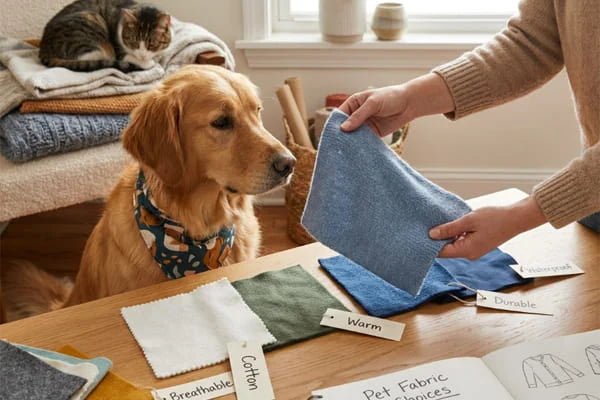
I receive fabric selection inquiries every week. Most messages start with "What’s the best fabric for pet clothing?" My first response is always another question: "What will your customer do with this garment?" That question usually creates silence, because the real decision framework isn’t about fabric properties—it’s about product positioning and care expectations that most buyers haven’t defined yet.
Fabric choice is not about finding the "best" material. It is about matching fiber performance to your product’s intended use case and the washing frequency your customer will realistically follow. Indoor comfort wear and outdoor functional gear require incompatible material properties1, and those differences cannot be resolved by switching suppliers or upgrading to "premium" versions of the same fiber.
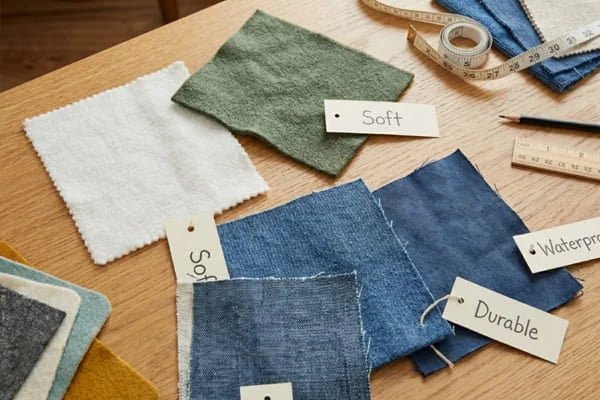
Most brand builders skip the positioning step and jump straight to material comparisons. This creates a mismatch between what their listing promises and what their chosen fabric can actually deliver at scale. Let me show you the decision framework I use during client intake, so you can clarify your requirements before you start comparing supplier quotes.
What Does "Best Fabric" Actually Mean in Your Product Context?
I ask every new client to describe their product’s primary function before I mention any fabric name. A sweater for indoor temperature regulation needs different fiber stability than a raincoat for muddy trail walks. The term "best fabric" has no meaning until you attach it to a specific task.
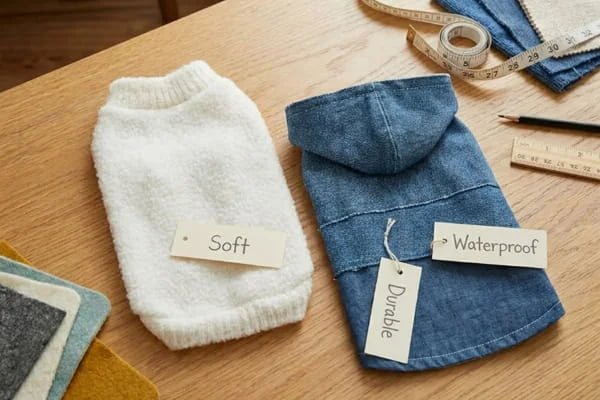
Your fabric choice must align with your product’s positioning: indoor comfort wear prioritizes softness and breathability over abrasion resistance, while outdoor functional gear requires water repellency and structural stability even when wet. These are incompatible property sets—you cannot optimize for both without performance compromises.
Why Product Positioning Determines Fiber Selection
Indoor comfort wear serves a different mechanical task than outdoor gear. A cotton-blend sweater must maintain softness after repeated washing because your customer will launder it frequently2. An outdoor jacket must retain shape stability when exposed to moisture and friction, even if the customer washes it infrequently.
Suppliers use terms like "soft," "breathable," and "durable," but these properties exist on trade-off curves. Adding polyester for durability reduces moisture absorption3, which affects how "soft" the fabric feels against skin. Treating cotton for water repellency adds stiffness4, which changes drape and breathability. You must decide which property cluster matches your product’s task before you evaluate any fabric sample.
I worked with a client who wanted a "soft, durable, breathable" fabric for a four-season sweater line. Those three properties require different fiber compositions depending on whether "durable" means "resists pilling after 30 washes" or "maintains shape when wet." We had to split the product line—one version optimized for indoor wear with high-wash-frequency cotton blends, another version for outdoor use with polyester-dominant construction. Trying to serve both use cases with one fabric created customer complaints about either insufficient softness or poor shape retention.
| Product Positioning | Primary Performance Requirement | Typical Fiber Direction | Trade-Off You Accept |
|---|---|---|---|
| Indoor comfort wear | Softness + high wash frequency tolerance | Cotton-dominant blends | Lower shape stability when wet |
| Outdoor functional gear | Water repellency + structural integrity | Polyester-dominant or treated fabrics | Reduced breathability, stiffer hand feel |
| Occasional-use fashion items | Visual appeal + low care demands | Mixed fibers with decorative finishes | May not survive frequent washing |
| Medical/recovery wear | Hypoallergenic + non-restrictive fit | Natural fibers, minimal chemical treatment | Limited durability in high-friction areas |
You cannot ask "which fabric is best" without first clarifying which row your product belongs in. Each positioning requires you to accept different performance boundaries.
How Does Care Frequency Change Fiber Stability Requirements?
Care frequency creates a hidden constraint that most brand builders overlook. A garment your customer washes weekly needs different fiber stability than one they wash seasonally, even if both are worn by the same pet type.
High-wash-frequency items require fibers that maintain colorfastness and dimensional stability across multiple laundry cycles. Low-wash-frequency items can use fibers optimized for other properties, because care-induced degradation happens more slowly. This difference affects cost structure and supplier selection.
Why Washing Frequency Affects Fiber Choice More Than Pet Size
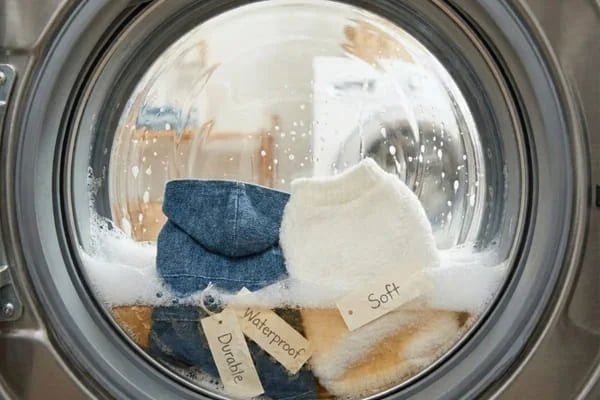
I receive many requests for "machine-washable pet clothing fabric," but that phrase has no standard definition. A cotton-polyester blend that survives 10 washes without significant pilling may fail at 30 washes if the polyester percentage is too low5. A pure cotton fabric may maintain softness across many washes but lose shape stability if the knit structure isn’t tight enough6.
Your customer’s care behavior determines which degradation mode you need to prevent. If your product is a daily-wear indoor sweater, your customer will wash it frequently, and you must prioritize colorfastness and shrinkage control. If your product is an occasional-use raincoat, your customer will wash it infrequently, and you can prioritize water repellency and structural stability over wash-cycle performance.
I worked with an Amazon seller who sourced a "premium soft cotton" fabric for a summer T-shirt line. The fabric felt excellent in hand samples, but customers reported severe pilling after five washes. The supplier had optimized for softness by using a looser knit structure, which reduced abrasion resistance7. The seller’s listing promised "everyday comfort," which implied high wash frequency, but the fabric was better suited for occasional-use items. We had to switch to a tighter-knit cotton-polyester blend that felt slightly less soft but maintained appearance across the customer’s actual care cycle.
| Care Frequency | Critical Fiber Stability Factor | Testing Question | Cost Impact |
|---|---|---|---|
| Weekly or more | Colorfastness, pilling resistance, shrinkage control8 | Does fabric maintain appearance after 30+ wash cycles? | Higher—requires tighter construction or higher polyester percentage |
| Monthly | Shape retention when wet, seam strength | Does fabric return to original dimensions after washing? | Moderate—can use natural fiber blends with moderate twist |
| Seasonal or less | Structural integrity, storage stability | Does fabric resist moisture damage during storage? | Lower—can prioritize other properties over wash-cycle performance |
You must ask your customer how often they will wash your product before you finalize fiber selection. This question surfaces performance boundaries that supplier spec sheets don’t show.
Why Supplier Marketing Terms Don’t Describe Functional Performance?
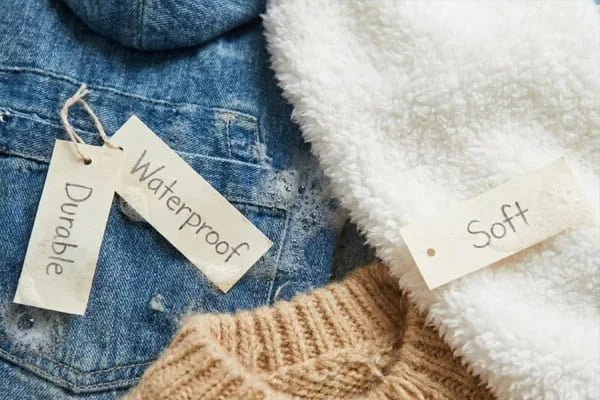
Suppliers describe fabrics using terms like "soft," "breathable," and "durable," but these words have no fixed meaning without construction context. A "soft" fabric can mean low abrasion resistance in one construction method and high pilling tendency in another. You cannot evaluate fabric suitability by reading supplier descriptions alone.
Supplier marketing terms describe subjective perceptions, not measurable performance boundaries. "Soft" depends on knit tightness and fiber diameter. "Breathable" depends on weave structure and finishing treatments. "Durable" depends on fiber blend ratio and the specific stress mode you’re testing. You must define what each term means in your product’s use case before you compare supplier offers.
How to Translate Supplier Claims Into Performance Requirements
I ask clients to replace every marketing term with a testable question. Instead of asking for "soft fabric," ask "Will this fabric maintain its hand feel after 20 washes under my customer’s care routine?" Instead of asking for "breathable fabric," ask "What is the moisture vapor transmission rate9 at the humidity level my product will encounter?"
Most small-scale sellers don’t have access to lab testing, so I recommend a simpler framework: ask suppliers to provide samples for your own washing tests. Launder the sample five times using the care instructions you plan to print on your label, then evaluate whether the fabric still meets your definition of "soft," "durable," or "breathable." If the supplier resists providing wash-test samples, that tells you their marketing claims may not survive real-world use.
I worked with a first-time brand builder who requested "breathable mesh fabric" for a summer vest. The supplier sent a sample that felt airy and lightweight, but after three washes, the mesh structure loosened significantly, creating gaps that allowed harness straps to snag10. The term "breathable" had described the fabric’s initial state, not its performance across multiple care cycles. We switched to a knit structure with engineered ventilation zones that maintained shape stability while providing adequate airflow.
| Marketing Term | Testable Performance Question | How to Verify Without Lab Access |
|---|---|---|
| Soft | Does hand feel remain consistent after multiple washes? | Wash sample 5 times and compare tactile perception |
| Breathable | Does fabric wick moisture away from skin? | Dampen sample and measure drying time in controlled conditions |
| Durable | Does fabric resist pilling and seam failure under friction? | Rub sample against itself 50 times and inspect for fiber damage |
| Stretch | Does fabric return to original dimensions after stretching? | Stretch sample to 120% and measure recovery after 10 minutes |
| Water-repellent | Does liquid bead up or soak through? | Apply water droplets and measure absorption time |
You must translate every supplier claim into a performance question that matches your product’s task. This prevents misalignment between your listing promises and your fabric’s actual capabilities.
How Do First-Time Brands Avoid Fabric-Positioning Mismatch?
Small-scale sellers and first-time brands often lack the vocabulary to describe their product positioning clearly. They request "soft cotton" without specifying indoor versus outdoor use, or ask for "durable polyester" without clarifying washing frequency. This creates a mismatch where the final product cannot deliver the performance the listing promises.
First-time brands should clarify three variables before requesting fabric samples: intended use environment, expected care frequency, and acceptable performance boundaries. Without these anchors, you will evaluate fabrics based on hand feel and supplier descriptions, which do not predict how your product will perform at scale.

What Questions to Answer Before You Contact Suppliers
I ask new clients to complete a positioning checklist before I show them any fabric options. This checklist forces them to articulate their product’s task and their customer’s care expectations:
- Will your customer wear this product indoors or outdoors primarily?
- How many hours per week will the product be worn?
- How often will your customer wash this product?
- What washing method will your label instructions specify?
- What performance trade-offs are you willing to accept?
Most first-time brands cannot answer the last question immediately, because they assume they can have all desirable properties simultaneously. My role is to show them the trade-off curves—adding water repellency reduces breathability, increasing durability may reduce softness, optimizing for frequent washing may increase cost.
I worked with an entrepreneur who wanted to launch a line of "premium everyday sweaters" using "the softest fabric available." I asked how often her target customer would wash the product. She estimated twice per week. I showed her that the softest cotton fabrics lose shape stability quickly under high wash frequency, and we needed to add polyester to maintain dimensional consistency. She initially resisted, believing polyester would feel "cheap," but after testing samples with her own dog, she realized the polyester blend maintained comfort longer than pure cotton. Her positioning required durability over maximum initial softness.
| Question | Why It Matters | How It Affects Fabric Choice |
|---|---|---|
| Indoor or outdoor primary use? | Determines whether you optimize for softness or weather resistance | Indoor = breathable natural fibers; outdoor = treated synthetics |
| Hours per week worn? | Reveals whether abrasion resistance is critical | High wear time = tighter weave or higher synthetic content |
| Washing frequency? | Determines colorfastness and shrinkage priorities | High frequency = requires stable dyes and pre-shrunk construction |
| Washing method? | Affects seam construction and finishing requirements | Machine wash requires reinforced seams; hand wash allows decorative finishes |
| Acceptable trade-offs? | Surfaces budget and performance boundaries | Clarifies whether you prioritize cost, feel, or durability |
You cannot skip this positioning work and expect your fabric choice to align with your customer’s expectations. Supplier samples will not reveal these mismatches—only real-world use will, and by then your inventory is already committed.
Conclusion
Fabric choice is not a parameter comparison exercise. It is a decision framework problem shaped by your product’s positioning, your customer’s care expectations, and the performance trade-offs you are willing to accept. Clarify those variables before you evaluate any supplier quote, and you will avoid the mismatch between your listing promises and your fabric’s actual capabilities at scale.
-
"Textile Innovations: The Rise of Smart Fabrics in Fashion Design", https://www.rmcad.edu/blog/textile-innovations-the-rise-of-smart-fabrics-in-fashion-design/. Textile engineering research demonstrates that fabrics optimized for moisture vapor transmission (breathability) typically exhibit reduced water repellency due to the porosity required for vapor transport, while water-resistant treatments that block liquid penetration simultaneously impede breathability. Evidence role: mechanism; source type: research. Supports: the inverse relationship between moisture vapor transmission and water repellency in textile construction. Scope note: This supports the general trade-off principle rather than specific pet clothing applications ↩
-
"Elucidation of Softening Mechanism in Rinse Cycle Fabric … – PMC", https://pmc.ncbi.nlm.nih.gov/articles/PMC4700061/. Studies of textile laundering effects show that cotton’s cellulosic structure can maintain surface softness through multiple wash cycles when blended appropriately, though pure cotton exhibits dimensional instability that synthetic fiber additions help mitigate. Evidence role: mechanism; source type: research. Supports: how cotton fiber structure responds to repeated laundering compared to synthetic fibers. Scope note: Research addresses general cotton behavior rather than specific pet apparel contexts ↩
-
"Increased Comfort of Polyester Fabrics – PMC", https://pmc.ncbi.nlm.nih.gov/articles/PMC8433904/. Polyester’s hydrophobic molecular structure results in moisture regain values of approximately 0.4% compared to cotton’s 7-8%, meaning polyester-dominant blends exhibit significantly reduced moisture absorption capacity. Evidence role: mechanism; source type: research. Supports: the hydrophobic nature of polyester and its effect on fabric moisture absorption. ↩
-
"Super-Hydrophobicity of Polyester Fabrics Driven by Functional …", https://pmc.ncbi.nlm.nih.gov/articles/PMC9957304/. Durable water repellent (DWR) treatments form a coating on fiber surfaces that increases fabric stiffness and reduces drape, as the chemical layer restricts fiber mobility and adds surface friction. Evidence role: mechanism; source type: research. Supports: how water repellent chemical treatments affect fabric mechanical properties. ↩
-
"Quantitative Assessment of Woven Fabric Surface Changes During …", https://pmc.ncbi.nlm.nih.gov/articles/PMC12348827/. Textile durability studies indicate that polyester content above 50% in cotton blends significantly improves pilling resistance, as the stronger synthetic fibers anchor loose cotton fibers and reduce surface fiber migration during abrasion. Evidence role: mechanism; source type: research. Supports: the relationship between synthetic fiber content and pilling resistance in blended fabrics. Scope note: Research establishes general trends rather than specific wash cycle thresholds ↩
-
"(PDF) An Investigation into the Dimensional Stability of 100% Cotton …", https://www.academia.edu/42668212/An_Investigation_into_the_Dimensional_Stability_of_100_Cotton_Fleece_Knit_Fabric. Textile engineering research shows that looser knit structures allow greater yarn mobility during laundering, leading to progressive dimensional changes in cotton fabrics as the hygroscopic fibers swell and contract, while tighter constructions restrict this movement. Evidence role: mechanism; source type: research. Supports: how knit construction density affects cotton fabric dimensional stability. ↩
-
"Evaluation of physical and mechanical characteristics of three … – PMC", https://pmc.ncbi.nlm.nih.gov/articles/PMC10685180/. Textile abrasion testing demonstrates that looser knit constructions exhibit reduced resistance to surface wear because the greater spacing between yarns allows easier fiber displacement and extraction under friction. Evidence role: mechanism; source type: research. Supports: the inverse relationship between knit looseness and abrasion resistance. ↩
-
"A Method for the Assessment of Textile Pilling Tendency Using …", https://pmc.ncbi.nlm.nih.gov/articles/PMC7374317/. International textile testing standards (ISO and AATCC) define colorfastness, pilling resistance, and dimensional stability as primary performance indicators for garments subjected to repeated laundering, with specific test methods for quantifying each property. Evidence role: definition; source type: institution. Supports: the standardized textile performance metrics for laundering durability. ↩
-
"Moisture Vapor Transmission Rate – Wilson College of Textiles", https://textiles.ncsu.edu/tpacc/comfort-performance/moisture-vapor-transmission-rate/. Moisture Vapor Transmission Rate (MVTR) is defined by ASTM E96 and ISO 15496 as the rate at which water vapor passes through a fabric, measured in grams per square meter per 24 hours, providing a quantitative metric for breathability. Evidence role: definition; source type: institution. Supports: the standardized measurement method for fabric breathability. ↩
-
"[PDF] Effect of Laundering on Dynamic Elastic Behavior of Cotton and …", https://jtatm.textiles.ncsu.edu/index.php/JTATM/article/viewFile/2593/1790. Textile research on open-structure fabrics shows that mesh constructions with low stitch density are susceptible to progressive relaxation during wet processing, as the reduced yarn interlocking allows structural rearrangement that increases aperture size. Evidence role: mechanism; source type: research. Supports: how mesh and open-structure knits can experience dimensional changes during laundering. Scope note: Research addresses general mesh behavior rather than specific pet clothing safety implications ↩