
Every month, I receive at least five urgent messages from buyers asking variations of the same question: “Can you send me your FDA certificate for pet products?” My answer always disappoints them: FDA doesn’t issue certificates for most pet supplies. This single misunderstanding has delayed shipments, stalled product launches, and cost importers thousands in expedited shipping fees when they discover the gap between what they requested and what actually matters for customs clearance.
Compliance for pet supplies isn’t about collecting certificates—it’s about understanding which regulatory framework applies to your product category, what documentation proves conformity, and where legal responsibility actually sits. FDA facility registration doesn’t equal product approval. CE marking for a leash requires different evidence than CE marking for an electronic toy. Material test reports confirm ingredient safety but don’t replace the importer’s obligation to verify full product compliance. These distinctions determine whether your first container clears customs smoothly or sits in a warehouse while you scramble to provide documents you should have requested six months earlier.
The certification questions buyers ask reveal a deeper problem: most haven’t identified which regulations their product actually triggers. A plush dog toy sold in California faces different requirements than the same toy sold in Germany, and both differ from what’s required for a stainless steel water bowl. When buyers request a generic “compliance package,” they’re asking us to guess which market they’re entering and which product risks matter—a recipe for incomplete documentation and failed audits.
What Does FDA Actually Regulate in Pet Supplies?
I’ve watched buyers halt production because they couldn’t locate an “FDA certificate” that never existed in the first place. The confusion stems from mixing up facility registration with product-level approval.
FDA oversight of pet products falls into two buckets: manufacturing facilities that need registration, and specific product categories that require pre-market approval or adherence to defined standards.1 Most conventional pet supplies—harnesses, beds, carriers, apparel—don’t require FDA product approval. They require that the manufacturing facility maintains registration and follows current good manufacturing practices if the product contains materials that contact food or water.

When FDA Registration Actually Matters
We maintain FDA facility registration because some of our clients import pet bowls, feeding mats, and travel water bottles—products where the pet supply functions as a food-contact article. Here’s what that registration proves:
- Our facility is registered in FDA’s database with a valid registration number
- We’ve designated a U.S. agent for regulatory communication
- We maintain records of manufacturing processes and material sourcing
- We can provide documentation during FDA inspections or import alerts
Registration doesn’t certify that your specific pet harness or plush toy meets FDA requirements. It certifies that our facility operates under trackable manufacturing controls.
The practical implication: when a buyer asks for “FDA certification,” I first ask which product they’re importing and whether it involves food contact, oral contact (chew toys), or cosmetic claims (shampoos marketed with drug-like benefits). A nylon leash needs zero FDA involvement. A silicone travel bowl requires facility registration and material compliance documentation. A “calming spray” marketed with therapeutic claims crosses into drug territory and requires entirely different approval pathways.
The Food Contact Trap
One of the costliest misunderstandings I’ve seen involved a buyer who ordered 5,000 silicone feeding mats without verifying FDA food-contact compliance. They assumed our facility registration covered product approval. It doesn’t.
Food-contact materials must comply with FDA regulations in 21 CFR 170-1892, which specify allowable substances, migration limits, and conditions of use. We provide:
- Material safety data sheets showing silicone composition
- Migration test reports from accredited labs (typically testing for volatile organics, heavy metals, and extractables under simulated-use conditions)
- Supplier declarations confirming food-grade status of raw materials
- Manufacturing process documentation showing no cross-contamination from non-food-contact production lines
The buyer needed to review these documents, confirm they matched their product specifications, and potentially conduct their own verification testing. They expected a single certificate that proved the mat was “FDA approved.” When customs requested detailed compliance documentation, they didn’t have it—because they’d never asked us for the right materials.
We ended up air-freighting corrected documentation, adding $1,800 to their import costs. The lesson: facility registration is step one; product-level compliance documentation is what customs and market surveillance authorities actually examine.
What FDA Doesn’t Cover
Most pet supplies sit outside FDA’s regulatory scope entirely:
- Textile products (beds, apparel, harnesses) → Consumer Product Safety Commission jurisdiction
- Mechanical toys without food contact → CPSC (US) or EN 71 (EU), not FDA
- Carriers and travel bags → General consumer product safety standards
- Grooming tools without cosmetic claims → State-level consumer protection, not federal pre-market approval
I spend more time explaining what FDA doesn’t regulate than what it does. Buyers assume “pet supply” equals automatic FDA oversight. In reality, only products that function as animal food, animal drugs, or food-contact materials trigger FDA requirements. Everything else falls under CPSC authority in the US, or equivalent national bodies in other markets.
| Product Type | FDA Oversight | Actual Regulatory Path |
|---|---|---|
| Nylon leash | None | CPSC general safety3 |
| Silicone feeding mat | Yes (food contact) | 21 CFR compliance + facility registration |
| Plush squeaky toy | None | CPSC + ASTM F9634 (if marketed to children) |
| Calming collar with pheromones | Potentially (drug claim) | FDA drug approval if therapeutic claim made |
| Stainless steel water bowl | Yes (food contact) | Material compliance + facility registration |
When a buyer sends a compliance checklist with “FDA certificate” as line item one, I know they haven’t mapped their product to the correct regulatory framework. We walk them through which jurisdiction actually applies—which prevents them from requesting documents that don’t exist and missing documents they actually need.
CE Marking: Self-Declaration vs. Notified Body Certification?
The second-most-common misconception I encounter: buyers requesting a “CE certificate” for products that only require a Declaration of Conformity. They’ve seen CE marks on products and assumed a third-party authority issues a certificate. For most pet supplies, that’s backwards.
CE marking is the manufacturer’s self-declaration that a product meets all applicable EU directives and regulations5. The manufacturer (or importer acting as the legal entity) signs a Declaration of Conformity, affixes the CE mark, and takes legal responsibility for compliance. No certificate required—unless the product falls under a directive that mandates Notified Body involvement.
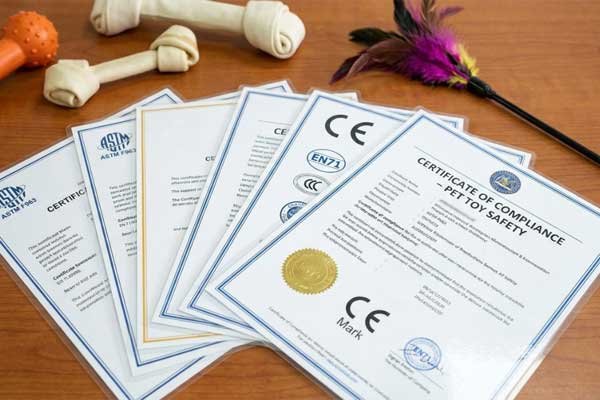
When Self-Declaration Suffices
Most conventional pet products fall outside high-risk categories that require Notified Body certification. Here’s what we prepare for a typical nylon harness or polyester pet bed destined for EU markets:
- Declaration of Conformity (DoC) – A signed document stating which directives apply (usually General Product Safety Directive), which harmonized standards we followed (if any), and our legal entity information
- Technical file – Material specifications, risk assessments, test reports for restricted substances (REACH, AZO dyes, phthalates), and manufacturing process documentation
- CE marking affixed to the product or packaging – Accompanied by our facility identification
No third-party certificate exists for these products. The buyer—as the importer and legal entity placing the product on the EU market—must verify our DoC, confirm the technical file supports the declaration, and accept liability for conformity.
I’ve had buyers refuse shipments because they expected a signed certificate from TÜV or SGS. Unless the product contains electronics (EMC/LVD directives), is classified as a toy under EN 71, or falls under another directive with mandatory third-party assessment, no Notified Body certificate will exist. The buyer’s insistence on a document that regulations don’t require reveals they haven’t read the applicable directives.
When Notified Body Involvement Is Mandatory
Certain product categories do require third-party conformity assessment. These situations trigger additional costs and timelines buyers must plan for:
- Electronic pet products (smart collars, automatic feeders with circuit boards) → EMC and LVD directives require testing and potentially Notified Body involvement depending on risk classification
- Toys intended for children under 14 (if the pet product could be used by children, such as plush toys with small parts) → EN 71 compliance6, sometimes requiring Notified Body testing for mechanical/physical properties and chemical composition
- Personal protective equipment (if a product is marketed for human safety during pet interaction, though rare in pet supplies)
When these scenarios apply, we coordinate with accredited testing labs to:
- Conduct required safety tests (EN 71-1, EN 71-2, EN 71-3 for toys; EN 50498 for electronic products)
- Obtain test reports that form the basis of the DoC
- In some cases, engage a Notified Body to review the technical file and issue an EU Type Examination Certificate (for products under New Approach directives with Module B assessment requirements)
Even when Notified Body involvement occurs, the manufacturer still issues the DoC—the Notified Body certificate supports the declaration but doesn’t replace it. The buyer still needs to verify the documentation chain and accept importer liability.
The Material Testing Confusion
Here’s a scenario I encounter monthly:
Buyer: “Can you provide the CE certificate for this leash?”
Us: “We provide a Declaration of Conformity and material test reports. No certificate exists for this product category.”
Buyer: “But I need proof it meets EU requirements.”
Us: “The DoC is the legal proof. The test reports show REACH compliance, AZO-free dyes, and tensile strength. What specific requirement are you verifying?”
Buyer: “I just need the CE certificate.”
This loop continues until we explain that material test reports prove specific claims (phthalate-free, heavy metal limits, colorfastness) but don’t replace the manufacturer’s DoC or the buyer’s obligation to verify conformity.
We provide:
- REACH SVHC testing7 (Substances of Very High Concern per EU regulation)
- Phthalate content (restricted under REACH Annex XVII)
- AZO dye testing (colorants that release carcinogenic amines)
- Tensile strength and stitching durability (product safety, not regulatory compliance per se)
These reports support the Declaration of Conformity. They don’t constitute “CE certification” because CE marking isn’t a certificate-based system for most products—it’s a legal declaration backed by documented evidence.
| Product Category | CE Marking Basis | Notified Body Required? |
|---|---|---|
| Fabric harness | Declaration of Conformity + REACH compliance | No |
| Polyester pet bed | Declaration of Conformity + material safety reports | No |
| Plush toy (sold as pet toy) | DoC + EN 71 compliance if risk exists | Sometimes (EN 71-1, 71-3) |
| Electronic smart collar | DoC + EMC/LVD test reports | Yes (if Class II or above) |
| Silicone feeding mat | DoC + food-contact material compliance | No (unless also making health claims) |
When buyers understand this structure, they ask better questions: “Which harmonized standards did you reference in the DoC?” “Can you provide the technical file for our records?” “What’s the timeline for EN 71-3 testing if we add a toy variant?” These questions lead to complete documentation and realistic timelines.
Material Safety Reports Don’t Equal Market Access?
The third major confusion point: buyers who believe a ream of material test reports automatically proves their product can enter a market. Test reports are evidence—but they’re not the full compliance story.
A phthalate-free test report confirms one restricted substance group doesn’t exceed limits. It doesn’t prove the entire product meets CPSIA requirements (in the US) or REACH Annex XVII restrictions (in the EU). It doesn’t verify labeling accuracy, traceability documentation, or import-country-specific packaging rules. Material reports are necessary but insufficient—compliance is a system, not a stack of PDFs.

What Material Reports Actually Prove
We maintain an extensive testing library covering common buyer requests:
- Heavy metals (lead, cadmium, mercury, chromium VI) per CPSC limits or EN 71-3
- Phthalates (DEHP, DBP, BBP, DINP, DIDP, DNOP) per CPSIA and REACH
- Formaldehyde content (textiles)
- AZO dyes (colorants restricted in EU)
- Tensile strength and seam durability (product performance, often used to support safety claims)
- Flammability (for certain fabric products under CPSC jurisdiction)
Each report addresses a specific risk. A phthalate report tells you the PVC coating on a leash handle doesn’t contain restricted plasticizers. It doesn’t tell you whether the metal D-ring meets lead content limits, whether the dye used in the webbing complies with AZO restrictions, or whether the product’s labeling claims (e.g., “heavy-duty for large dogs”) match actual tensile test results.
Compliance requires mapping every component to applicable restrictions, conducting relevant tests, and documenting the decision trail. When a buyer requests “all compliance reports,” I ask which market they’re entering and which claims they’re making—because the testing matrix changes based on those variables.
The Importer’s Responsibility Gap
Material test reports create a false sense of security because they shift focus away from the importer’s legal obligations. In both the US and EU, the importer is the legal entity responsible for ensuring the product meets all applicable requirements before placing it on the market8.
This means:
- Verifying that test reports cover all restricted substances for the target market
- Confirming that the manufacturer’s Declaration of Conformity (EU) or General Certificate of Conformity (US) accurately reflects product composition and test results
- Ensuring labeling complies with local language and content requirements (fiber content, country of origin, care instructions, safety warnings)
- Maintaining traceability documentation (batch records, supply chain declarations) in case of recalls or market surveillance inquiries
- Updating compliance documentation when materials, suppliers, or regulatory standards change
I’ve seen buyers assume our test reports discharge their legal obligations. They don’t. Reports prove we tested specific parameters under specified conditions—the importer must verify those parameters match their product’s actual risks and market requirements.
A concrete example: We produced a line of dog beds with removable covers. The polyester fabric tested free of restricted AZO dyes and formaldehyde. The zipper tested below lead content limits. The filling passed flammability standards. The buyer received all reports, assumed compliance was complete, and imported the beds into California.
They didn’t verify that California’s Proposition 65 warning requirements9 applied to the product. The beds contained polyurethane foam (a material that can release trace amounts of formaldehyde during degradation). While our formaldehyde test showed levels well below CPSC limits, California requires warnings for any intentionally added chemicals on the Prop 65 list—even at levels that don’t trigger federal limits.
The buyer faced enforcement action because they relied solely on our material reports without cross-checking California-specific requirements. We provided the data needed for federal compliance; they didn’t verify state-level obligations.
When Test Reports Become Obsolete
Material compliance isn’t static. Regulatory updates, supply chain changes, and formula adjustments can make last year’s test report irrelevant:
- REACH SVHC list updates twice yearly10 – A material that tested compliant in January may contain newly restricted substances by July
- Supplier changes – If we switch fabric mills or zipper suppliers, previous test reports no longer represent current production
- Product modifications – Adding a new colorway, changing webbing thickness, or updating a buckle style can introduce new compliance risks
We track these variables internally, but buyers often request “current test reports” without specifying what “current” means. Is it the most recent test of the current production batch, or the most recent test of the product design (which may predate their order by six months)?
Best practice: Request batch-specific test reports for critical components, especially if regulatory updates or supplier changes occurred since the original compliance documentation was prepared. If a buyer orders in March and we tested materials in October, ask whether any formula changes, REACH updates, or supplier transitions occurred in the interim.
- “How do I Start an Animal Food Business?”, https://www.fda.gov/animal-veterinary/animal-foods-feeds/how-do-i-start-animal-food-business. The FDA’s Center for Veterinary Medicine oversees manufacturing facility registration requirements and product-specific approvals for animal food, drugs, and medical devices, as outlined in the Federal Food, Drug, and Cosmetic Act and implementing regulations. Evidence role: general_support; source type: government. Supports: FDA’s regulatory framework distinguishing facility registration requirements from product-specific pre-market approval. Scope note: Source describes the general regulatory framework; specific product categorizations may require additional CFR references ↩
- “21 CFR Part 170 — Food Additives”, https://www.ecfr.gov/current/title-21/chapter-I/subchapter-B/part-170. Title 21 of the Code of Federal Regulations, parts 170-189, establishes FDA requirements for food additives and food-contact substances, including specifications for allowable materials, conditions of use, and migration limits. Evidence role: definition; source type: government. Supports: the specific CFR sections governing food-contact substances, allowable materials, and migration testing requirements. ↩
- “Products Under the Jurisdiction of Other Federal Agencies and …”, https://www.cpsc.gov/Regulations-Laws–Standards/Products-Outside-CPSCs-Jurisdiction. The Consumer Product Safety Commission regulates thousands of consumer product types under the Consumer Product Safety Act, including general pet supplies that are not food, drugs, or medical devices regulated by other federal agencies. Evidence role: general_support; source type: government. Supports: CPSC’s general jurisdiction over consumer products including pet supplies that don’t fall under FDA or other specific agency authority. ↩
- “ASTM F963 Requirements”, https://www.cpsc.gov/Business–Manufacturing/Business-Education/Toy-Safety/ASTM-F-963-Chart. ASTM F963, Standard Consumer Safety Specification for Toy Safety, developed by ASTM International, establishes safety requirements for materials, physical and mechanical properties, flammability, and labeling of toys intended for children under 14 years of age. Evidence role: definition; source type: institution. Supports: ASTM F963 as the standard consumer safety specification for toy safety in the United States. ↩
- “Compliance FAQs: CE Marking | NIST”, https://www.nist.gov/standardsgov/compliance-faqs-ce-marking. Under EU regulations, CE marking constitutes the manufacturer’s declaration that a product conforms to all applicable EU harmonization legislation, with the manufacturer taking full responsibility for conformity assessment except where Notified Body involvement is mandated. Evidence role: definition; source type: government. Supports: the legal definition and self-declaration nature of CE marking under EU law. ↩
- “EN 71”, https://en.wikipedia.org/wiki/EN_71. The EN 71 series, developed by the European Committee for Standardization (CEN), provides harmonized standards supporting the EU Toy Safety Directive, with parts covering mechanical and physical properties (EN 71-1), flammability (EN 71-2), and migration of certain elements (EN 71-3). Evidence role: definition; source type: institution. Supports: the EN 71 series as harmonized European standards for toy safety covering mechanical, flammability, and chemical properties. ↩
- “Substance of very high concern”, https://en.wikipedia.org/wiki/Substance_of_very_high_concern. Regulation (EC) No 1907/2006 (REACH) establishes a candidate list of Substances of Very High Concern maintained by the European Chemicals Agency, requiring manufacturers and importers to provide information when articles contain these substances above specified thresholds. Evidence role: definition; source type: government. Supports: the REACH regulation’s framework for identifying and restricting Substances of Very High Concern. ↩
- “CPSC Implements Mandatory eFiling for Certificates of …”, https://www.cpsc.gov/Newsroom/News-Releases/2026/CPSC-Implements-Mandatory-eFiling-for-Certificates-of-Compliance-Targeting-Dangerous-Foreign-Imports. EU product safety regulations designate importers as economic operators with explicit duties to ensure products comply with applicable requirements and bear CE marking where required before placing products on the market; similarly, US agencies including CPSC hold importers accountable for ensuring imported products meet applicable federal safety standards. Evidence role: general_support; source type: government. Supports: the legal responsibility of importers to verify product compliance before market placement in both EU and US frameworks. Scope note: Specific obligations vary by product category and applicable regulations in each jurisdiction ↩
- “The Proposition 65 List – OEHHA – CA.gov”, https://oehha.ca.gov/proposition-65/proposition-65-list. California’s Safe Drinking Water and Toxic Enforcement Act of 1986 (Proposition 65) requires warnings before exposing individuals to chemicals listed as causing cancer or reproductive harm, with warning thresholds established independently of federal regulatory limits and based on risk assessment principles. Evidence role: general_support; source type: government. Supports: Proposition 65’s requirement for warnings based on listed chemical exposure, which may differ from federal regulatory thresholds. Scope note: The relationship between Prop 65 ‘safe harbor’ levels and federal limits varies by chemical and may not always be more restrictive ↩
- “Candidate List – ECHA CHEM”, https://chem.echa.europa.eu/obligation-lists/candidateList. The European Chemicals Agency typically updates the SVHC candidate list twice annually, though the exact timing depends on the evaluation and authorization process for identified substances of very high concern. Evidence role: general_support; source type: institution. Supports: the typical frequency of REACH SVHC candidate list updates by ECHA. Scope note: Update frequency is a general pattern rather than a mandated regulatory schedule ↩