
The pet accessories industry is facing a quiet but pivotal shift. Brand managers now receive regular inquiries from retailers asking about eco-credentials before placing purchase orders. E-commerce sellers watch conversion rates climb when product descriptions include material sustainability details. Yet behind these market signals sits a harder question that most brands are asking incorrectly: "Should we go eco-friendly?" The real question is: "Which eco-materials match our product performance requirements, target certifications, and order volume constraints?"
From our manufacturing floor perspective, eco-friendly pet accessories in 2026 represent a material selection problem, not a brand positioning gamble. Brands that treat this as a binary yes/no decision waste budget on wrong-market certifications and incompatible materials. The profit opportunity exists for brands that understand eco-materials as performance trade-offs constrained by certification geography, cost structure, and supplier testing capability—not as universally superior alternatives to conventional production.
This shift matters because the repeat order dynamics have fundamentally changed. We track order patterns across our client base—brands that launch eco-material lines return for repeat orders at significantly higher rates than those running conventional product lines. This is not trend-chasing. This is market structure: brands discover that eco-suppliers function as development partners who can navigate certification complexity, not just fulfillment vendors. The brands capturing profit in 2026 will be those who enter with clear material requirements and realistic cost expectations, not those hoping to add "eco-friendly" as a marketing label.
Why Are Eco-Friendly Pet Accessories Gaining Market Traction in 2026?
Buyer behavior is driving this shift, not manufacturer enthusiasm. Brand managers tell us their retailers now request certification documentation during product onboarding. E-commerce sellers report that Amazon listings with verified eco-credentials achieve better conversion rates in competitive product categories1.
The core driver is regulation pressure filtering down to consumer expectations. EU markets have implemented stricter packaging and material disclosure requirements2. US states are introducing their own pet product safety standards3. Brands positioned between these requirements and end-consumer preferences now view eco-materials as risk management—a way to future-proof product lines against tightening compliance requirements while meeting rising consumer expectations.
What we observe from client sourcing decisions: brands launching eco-lines in 2026 are treating this as supply chain strategy, not marketing experimentation. They expect longer product lifecycles, fewer compliance revisions, and stronger retailer relationships. The brands that succeed will be those approaching this as a material engineering problem with clear performance targets and budget constraints.
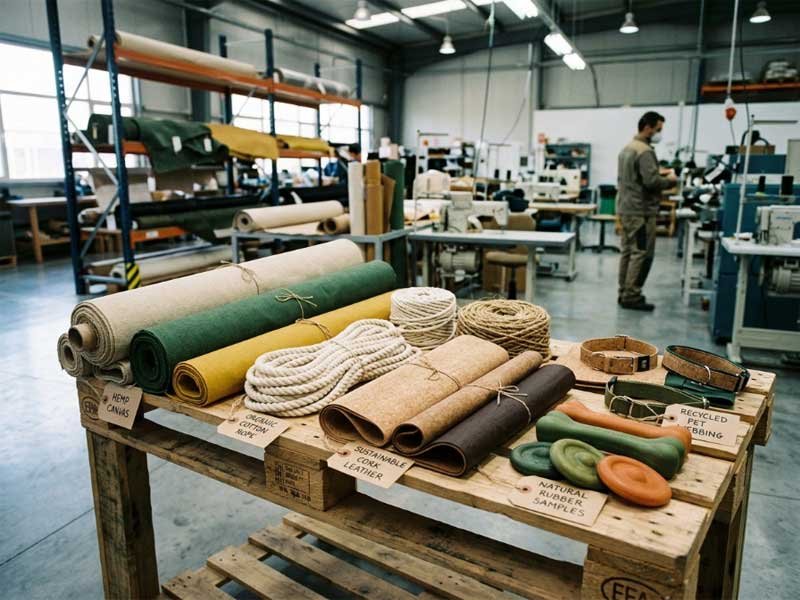
This creates a supplier selection problem. Brands need manufacturing partners who understand certification geography differences, have tested material performance boundaries, and can maintain quality across volume fluctuations. The inquiry volume we receive reflects this: detailed questions about specific certifications, material durability comparisons, and MOQ flexibility—not generic requests for "eco-friendly options."
The profit opportunity emerges from repeat orders. Brands that launch successfully convert their eco-supplier into a long-term partner because navigating certification and material trade-offs requires institutional knowledge. One-time orders waste everyone’s resources. Stable partnerships create pricing efficiency, inventory predictability, and faster product iteration.
The brands missing this opportunity are those treating eco-materials as a checkbox item. They request samples, receive quotes, then delay decisions because they haven’t resolved internal questions about target market certifications or acceptable performance trade-offs. Meanwhile, their competitors who clarified these constraints six months earlier are already capturing shelf space.
Which Eco-Materials Actually Work for Pet Accessories?
Material selection is where most brands waste budget. They assume "biodegradable" means universal performance compromise or that "recycled content" automatically reduces durability. Both assumptions are false under specific conditions.
We work with several material categories, each with distinct performance boundaries:
Recycled polyester blends function identically to conventional polyester in dry-use applications like pet carriers, backpacks, and harness webbing. The performance gap only emerges under prolonged UV exposure or when used in constantly wet environments. For 80% of pet accessory applications, clients cannot identify performance differences between recycled and virgin polyester in blind testing. Yet the price premium is only 8–12% at our production volumes.
Organic cotton is where brands make the most specification errors. They request organic cotton for products requiring frequent washing or heavy wear—applications where conventional cotton already performs poorly. Organic cotton certifications address agricultural practices, not fabric durability. When we recommend organic cotton, it’s for products where softness and skin contact matter more than abrasion resistance: pet beds, plush toy exteriors, or apparel lining. For leashes, collars, or harnesses under load, organic cotton introduces failure risk without performance benefit.

Hemp-blend webbing surprises clients. It outperforms conventional nylon in tensile strength and resists mold growth better than polyester. The trade-off is texture: hemp webbing has a rougher hand-feel that some brands reject for aesthetic reasons. We recommend hemp blends for hiking gear, outdoor harnesses, and travel accessories where performance justifies the texture difference. It’s a poor choice for fashion-focused products where tactile experience drives purchase decisions.
Biodegradable plastics are the most misunderstood category. Clients request biodegradable buckles, clips, and hardware without understanding degradation conditions. Most biodegradable plastics require industrial composting facilities to break down—they will not degrade in landfills or home compost bins within relevant timeframes4. We test biodegradable hardware for products targeting EU markets where industrial composting infrastructure exists. For US markets, we recommend recycled conventional plastics instead because the end-of-life infrastructure doesn’t support biodegradable claims.
Material Performance Testing: What We Actually Validate
We test materials for manufacturing feasibility, not laboratory-grade proof. Our testing answers specific questions:
- Can this material maintain dimensional stability through our production process?
- Does it meet minimum performance thresholds for the intended product application?
- Will it pass the certifications the client’s target market requires?
We do not extrapolate these results into broad scientific claims. We validate whether a material works for a specific product within a defined use case.
Material Cost Reality Check
Brands get surprised by cost structure, not unit prices. The price premium for eco-materials has stabilized: recycled polyester adds 8–12%, organic cotton adds 15–20%, hemp blends add 20–25% compared to conventional alternatives. These premiums have actually decreased since 2023 as supply chains matured.
The real cost barrier is MOQ structure. Eco-material suppliers require higher minimum order quantities because their supply chains lack the depth of conventional material networks. A brand ordering 500 units can easily source conventional nylon webbing. That same brand faces 2,000-unit minimums for certified hemp webbing. The unit cost difference is acceptable; the inventory risk from 4x higher MOQ pricing out small brands at the sourcing stage.
Material Selection Decision Framework
| Use Case | Recommended Material | Performance Trade-off | Price Premium |
|---|---|---|---|
| Pet carriers, backpacks | Recycled polyester | None (dry conditions) | 8–12% |
| Harnesses, leashes | Hemp-blend webbing | Rougher texture | 20–25% |
| Beds, plush toys | Organic cotton | Lower abrasion resistance | 15–20% |
| Hardware, buckles (EU) | Biodegradable plastics | Requires industrial composting | 18–22% |
| Hardware, buckles (US) | Recycled conventional plastics | None | 5–8% |
This framework reflects what we validate through prototyping and client feedback. It is not comprehensive material science—it’s manufacturing-floor observation translated into sourcing guidance.
Do EU and US Eco-Certifications Actually Overlap?
They don’t, and brands waste significant budget assuming otherwise. This is the most expensive misconception we encounter during initial client consultations.
EU certification does not grant US market compliance. US certification does not satisfy EU regulatory requirements. Eco-standards are not universal. Brands that budget for one certification set discover midway through development that their target market requires completely different documentation.
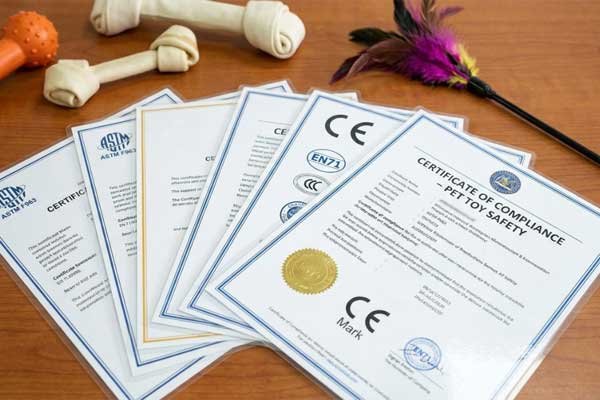
EU markets prioritize life-cycle and chemical safety standards. The most common certifications we help clients pursue for EU distribution are:
- OEKO-TEX Standard 100: Tests for harmful substances in textiles. Required by many EU retailers for pet products with fabric components.
- GOTS (Global Organic Textile Standard): Certifies organic fiber content and processing methods. Necessary for organic cotton claims in EU markets.
- FSC (Forest Stewardship Council): Applies to wood components in pet furniture or packaging. EU retailers increasingly require this for shelf approval.
These certifications focus on material sourcing transparency, chemical composition limits, and processing method verification. They do not address US market concerns about product safety claims or FDA pet product compliance.

US markets prioritize safety performance and claim substantiation. The compliance landscape is more fragmented because individual states introduce their own requirements:
- California Prop 65: Requires warning labels for products containing specific chemicals. Affects accessories with metal hardware or dyed components.
- CPSIA (if products could be used by children): Applies to pet accessories that might double as children’s items. Testing requirements overlap with toy safety standards.
- State-specific pet product safety laws: Several US states have introduced their own pet product material restrictions, creating a patchwork compliance environment.
US buyers also request USDA BioPreferred certification for products marketed as bio-based, though this is voluntary, not mandatory. The certification verifies bio-based content percentage but does not address safety or performance.
The Certification Gap That Costs Brands Money
Brands targeting both markets must budget for dual certification paths. This approximately doubles compliance costs because testing protocols don’t transfer. A product certified OEKO-TEX Standard 100 for EU distribution still requires separate US chemical composition testing if California Prop 65 applies.
We see brands make two expensive mistakes:
Mistake 1: Launch EU-focused products, then attempt US market expansion using EU certifications. This requires complete retesting, often revealing formulation issues that necessitate product redesign. The redesign cost exceeds what proper planning would have invested upfront.
Mistake 2: Assume "eco-friendly" is a universal claim defensible with any certification. Regulatory bodies assess specific claims against specific standards. "Biodegradable" claims face scrutiny from FTC Green Guides in the US and different standards under EU Directive 94/62/EC5. Brands using identical marketing language across markets face compliance challenges in at least one jurisdiction.
Certification Strategy We Recommend to Clients
For brands launching in single markets: Pursue only the certifications your target market requires. Don’t pay for certifications that don’t translate to shelf approval or consumer trust in your geography.
For brands planning multi-market expansion: Budget for parallel certification paths from the start. Design products to meet both EU chemical composition limits and US safety performance requirements. This increases upfront development cost but eliminates expensive redesigns later.
For e-commerce sellers without retail relationships: Prioritize claim substantiation over comprehensive certification. Amazon and other platforms require proof for eco-claims, but accepted proof varies by market. US sellers need documentation supporting FTC Green Guide compliance. EU sellers need documentation meeting Directive 2005/29/EC standards for environmental claims.
Material Testing and Certification Timeline
Brands consistently underestimate certification timelines. From our experience managing client projects:
- EU OEKO-TEX Standard 100 testing: 4–6 weeks after sample submission
- GOTS certification (if supply chain not pre-certified): 8–12 weeks for supply chain verification
- US California Prop 65 testing: 3–4 weeks after sample submission
- Multi-component product certification (combining materials, hardware, and packaging): 10–16 weeks total
These timelines assume no test failures requiring reformulation. Failed tests add 6–8 weeks for material adjustment and retesting.
Smart brands build these timelines into product launch planning. Brands that don’t face delayed market entry, missed seasonal windows, and cash flow problems from inventory sitting in compliance limbo.
How Do Eco-Materials Actually Affect Product Durability?
The assumption that biodegradable equals compromised durability is false, but the reality is more nuanced than "eco-materials perform just as well."
Performance depends on use case, not material category. Certain eco-materials outperform conventional alternatives in specific conditions. Others introduce genuine trade-offs that brands must evaluate against their product positioning and warranty expectations.
From prototyping and client feedback, here’s what we actually observe:
Materials That Outperform in Dry Conditions
Recycled polyester in pet carriers and backpacks shows no measurable performance difference from virgin polyester in our abrasion testing. The recycling process does not meaningfully reduce fiber strength for applications where the fabric experiences intermittent load cycles and minimal UV exposure. Pet carriers used for occasional travel maintain structural integrity identically to conventional polyester equivalents.
The performance gap emerges under prolonged outdoor exposure. UV degradation accelerates slightly faster in recycled polyester6, though the difference is measured in months of continuous outdoor use—irrelevant for most pet accessory applications.
Hemp-blend webbing under tensile load surprises brands. It exceeds conventional nylon in breaking strength and resists mold growth better than polyester. The fiber structure creates natural antimicrobial properties useful for gear exposed to moisture. We’ve tested hemp-blend harnesses through repeated wet/dry cycles without the degradation conventional materials show.
The trade-off is aesthetic, not functional. Hemp webbing has a coarser texture and limited color options. Brands focused on fashion-forward design reject it even after seeing performance data. Brands prioritizing function for outdoor/hiking accessories adopt it readily.
Materials With Real Performance Constraints
Organic cotton in high-wear applications is where we redirect clients most often. Organic certification addresses growing practices, not fabric engineering. The resulting textile has identical durability characteristics to conventional cotton—which means poor performance for leashes, harnesses, or collars subject to abrasion and repeated stress.
We recommend organic cotton only for products where skin contact and softness matter more than structural load-bearing: pet bed covers, plush toy exteriors, or apparel lining. Using organic cotton for a leash because "customers want eco-friendly" introduces failure risk without performance benefit.
Biodegradable plastics in hardware components require careful application matching. The materials we test degrade under specific conditions—typically industrial composting facilities with controlled temperature and microbial activity. They will not degrade in landfills or home compost bins within any timeframe relevant to consumer expectations.
The mechanical properties also differ from conventional plastics. Biodegradable buckles have lower impact resistance and fail under cold temperatures that conventional plastics handle easily. We recommend them only for products targeting EU markets where end-of-life infrastructure supports the degradation claims, and where the use case doesn’t involve extreme temperature or impact stress.
The Testing We Actually Conduct
Our testing is manufacturing-focused, not laboratory research. We validate:
Abrasion resistance: Running samples through repeated friction cycles to identify premature wear patterns. We’re testing whether materials survive our production process and typical product use, not generating peer-reviewed data.
Load-bearing capacity: Applying tensile stress to webbing, stitching, and hardware connections to verify minimum safety thresholds. We’re confirming products won’t fail under rated load specifications.
Environmental stress: Exposing samples to wet/dry cycles, temperature variation, and UV light to identify degradation patterns. We’re checking whether materials maintain integrity through expected product lifetime, not extrapolating long-term environmental impact.
This testing tells us whether a material works for a specific product application. It does not generate the comprehensive performance data that material science research produces. Brands need to understand this distinction—we validate manufacturing feasibility, not publish durability benchmarks.
Performance Testing Results Clients Need to Interpret Carefully
When we report that "hemp-blend webbing outperforms conventional nylon in tensile strength," we mean it exceeded breaking strength thresholds in our specific testing protocol under controlled conditions. We do not mean it universally outperforms across all possible stress scenarios.
When we note "recycled polyester shows no performance difference in dry conditions," we’re reporting results from our abrasion testing of pet carrier applications. We are not claiming comprehensive equivalence across all polyester applications.
Clients who treat our testing observations as definitive material science conclusions set themselves up for problems. Our role is narrower: we identify which materials work for specific products within defined use cases, validated through prototyping and client feedback.
Real-World Performance Feedback Loop
The most valuable performance data comes from client repeat orders and return rates. Brands that launch eco-material products report back on field performance:
- Recycled polyester pet carriers: Return rates statistically equivalent to conventional polyester versions
- Hemp-blend harnesses: Lower return rates than conventional nylon harnesses, primarily due to superior mold resistance in humid climates
- Organic cotton beds: Higher return rates when marketed as "durable" but acceptable rates when positioned correctly as premium comfort products
- Biodegradable hardware: Higher failure rates in cold climates, acceptable performance in temperate EU markets
-
"A systematic review on how environmental sustainability …", https://pubmed.ncbi.nlm.nih.gov/41669911/. Research on consumer behavior indicates that environmental certifications and sustainability claims can positively influence purchase decisions in e-commerce contexts, though the magnitude of effect varies by product category and consumer demographic. Evidence role: general_support; source type: research. Supports: consumer behavior research showing eco-credentials influence online purchasing decisions. Scope note: Studies measure general eco-label effects rather than specifically Amazon pet accessory conversion rates ↩
-
"Report Name:Exporting Feed and Pet Food to the EU", https://apps.fas.usda.gov/newgainapi/api/Report/DownloadReportByFileName?fileName=Exporting+Feed+and+Pet+Food+to+the+EU_Brussels+USEU_European+Union_E42026-0017.pdf. The European Union has progressively strengthened packaging waste regulations through amendments to Directive 94/62/EC and related frameworks, establishing material disclosure and recyclability requirements for consumer products across member states. Evidence role: general_support; source type: government. Supports: EU regulatory framework for packaging and material disclosure in consumer products. ↩
-
"Pet Food | FDA", https://www.fda.gov/animal-veterinary/animal-foods-feeds/pet-food. Several US states have introduced or considered pet product safety legislation addressing material restrictions and labeling requirements, creating a fragmented regulatory landscape that varies by jurisdiction. Evidence role: general_support; source type: government. Supports: state-level regulatory activity regarding pet product safety. Scope note: Regulatory activity varies significantly by state and product category ↩
-
"The Life Cycle Assessment for Polylactic Acid (PLA) to Make It …", https://pmc.ncbi.nlm.nih.gov/articles/PMC8199738/. Research on biodegradable plastics demonstrates that materials certified as compostable typically require industrial composting conditions—including controlled temperature, moisture, and microbial activity—to degrade within specified timeframes, with significantly slower or negligible degradation occurring in landfill or home composting environments. Evidence role: mechanism; source type: research. Supports: degradation conditions and timeframes for biodegradable plastics. ↩
-
"Green Guides", https://www.ftc.gov/news-events/topics/truth-advertising/green-guides. The US Federal Trade Commission’s Green Guides provide guidance on environmental marketing claims to prevent deception, while EU frameworks including Directive 94/62/EC and Directive 2005/29/EC establish requirements for environmental claims specific to packaging and commercial practices, creating distinct compliance obligations across jurisdictions. Evidence role: general_support; source type: government. Supports: regulatory frameworks governing environmental marketing claims in US and EU markets. ↩
-
"Degradation of Mechanical Properties of A-PET Films after UV …", https://pmc.ncbi.nlm.nih.gov/articles/PMC10610990/. Material science research on recycled polyester indicates that UV degradation rates can be influenced by recycling process variables and the presence of residual contaminants, though differences from virgin polyester are generally modest under typical use conditions. Evidence role: mechanism; source type: research. Supports: UV degradation characteristics of recycled versus virgin polyester. Scope note: Degradation rates vary with recycling process quality, fiber treatment, and specific exposure conditions ↩